Generative AI vs Agentic AI
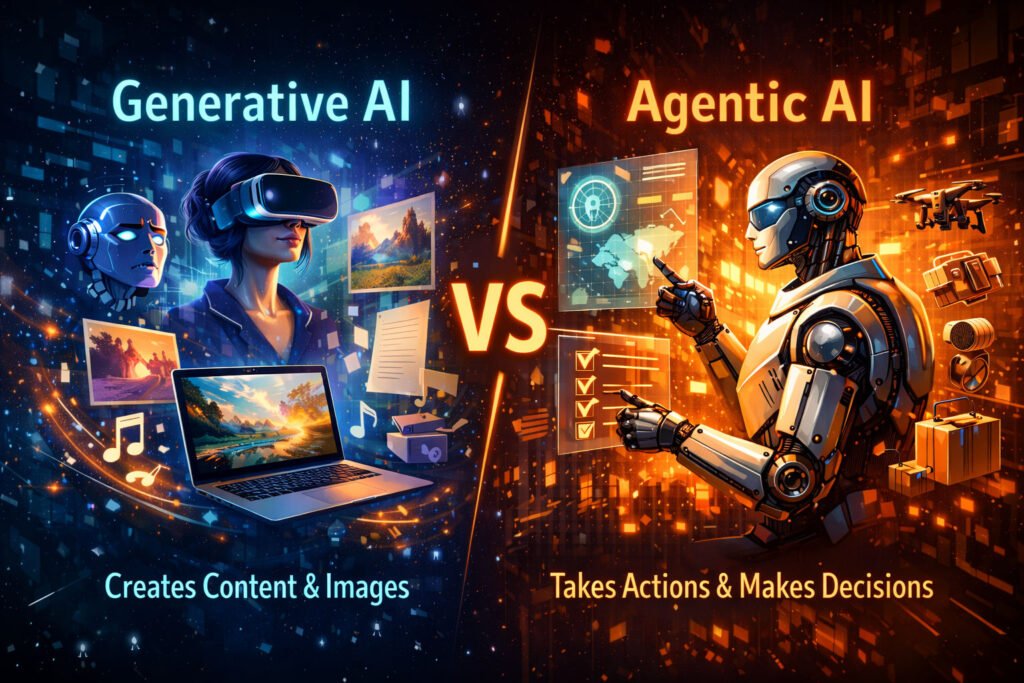
Artificial Intelligence (AI) has evolved rapidly, leading to the development of different approaches designed for specific tasks. Two of the most important paradigms today are Generative AI and Agentic AI. While both fall under the AI umbrella, they differ in how they function, what they are designed to achieve, and where they are applied. Generative AI focuses on creating new content from learned data patterns, whereas Agentic AI emphasizes autonomy, decision-making, and goal-oriented actions.
Key Differences at a Glance
- Generative AI creates content such as text, images, code, and audio
- Agentic AI takes actions, makes decisions, and works toward goals
- Generative AI is prompt-driven and reactive
- Agentic AI is autonomous and proactive
- Generative AI is widely used in creative and content-focused tasks
- Agentic AI is commonly used in automation and decision-making systems
Definition of Generative AI
Generative AI refers to a class of artificial intelligence systems designed to create new content—such as text, images, audio, video, or code—by learning patterns from existing data. Instead of simply analyzing or classifying information, Generative AI produces original outputs that resemble human-created content.
Introduction to Generative AI
Generative AI has gained widespread attention due to its ability to mimic creativity and language understanding at scale. These systems are trained on large datasets and learn statistical patterns that allow them to generate coherent, contextually relevant outputs. Popular examples include text generation models, image synthesis tools, and music composition systems.
At its core, Generative AI focuses on content creation, making it especially valuable in domains where speed, personalization, and creativity are important.
Key Characteristics of Generative AI
Some defining characteristics of Generative AI include:
- Data-driven learning: Trained on massive datasets to identify patterns and structures
- Probabilistic output generation: Produces results based on likelihood rather than deterministic rules
- Creativity simulation: Generates novel content that did not previously exist
- Prompt-based interaction: Relies on user input (prompts) to guide output
Stateless behavior: Typically does not take long-term actions or make autonomous decisions
Applications of Generative AI
Generative AI is widely used across industries, including:
- Text generation for blogs, reports, and documentation
- Image and video creation for marketing and design
- Code generation and software assistance
- Chatbots and conversational interfaces
- Music, art, and creative experimentation
Understanding Agentic AI
Agentic AI represents a different evolution of artificial intelligence, focusing on autonomy and action rather than content creation. It is designed to operate as an intelligent agent capable of independent decision-making.
- Emphasizes goal-oriented behavior instead of generating text, images, or media
- Designed to act autonomously with minimal human intervention
- Can perceive and understand its environment using real-time data and signals
- Capable of planning, reasoning, and selecting actions to achieve specific objectives
- Executes multi-step tasks rather than responding to single prompts
- Continuously monitors outcomes and adapts behavior based on feedback
- Integrates with tools, systems, and workflows to perform real-world actions
- Operates effectively in dynamic and changing environments
Definition of Agentic AI
Agentic AI is defined as an AI system capable of autonomous action, where it can plan, reason, decide, and execute tasks over time with minimal human intervention. Unlike Generative AI, which responds to prompts, Agentic AI operates continuously within an environment.
Introduction to Agentic AI
Agentic AI builds on decades of research in intelligent agents, robotics, and decision theory. These systems are often deployed in dynamic environments where conditions change and decisions must be adjusted in real time. Agentic AI is not limited to producing outputs; it is designed to act.
Key Differences Between Generative AI and Agentic AI
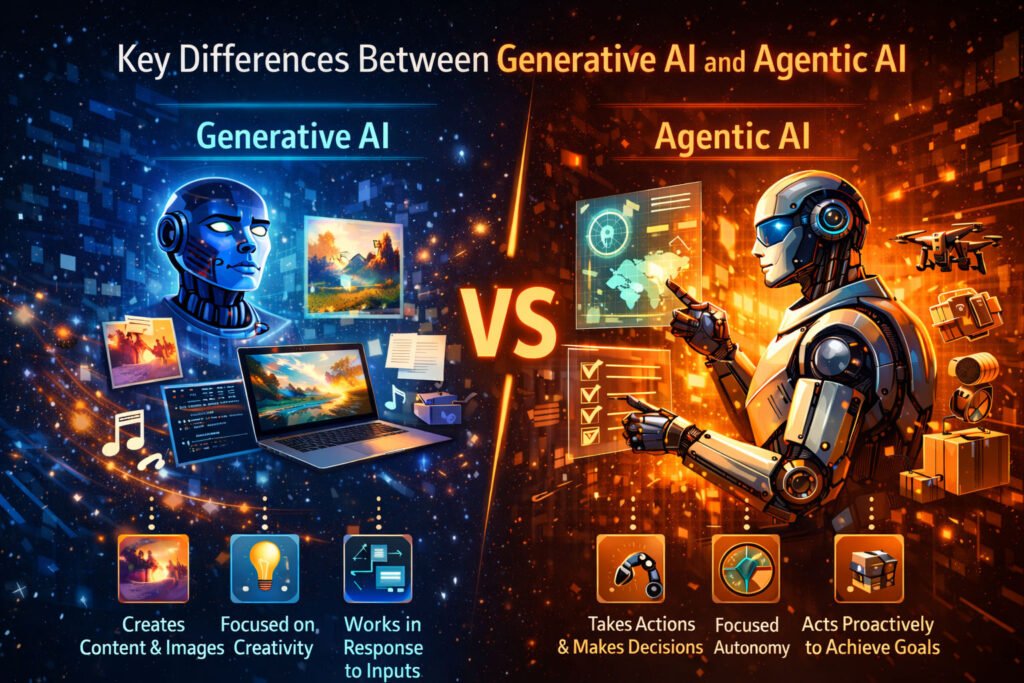
The primary differences between Generative AI and Agentic AI can be summarized as follows:
- Purpose: Generative AI creates content; Agentic AI achieves goals
- Autonomy: Generative AI is reactive; Agentic AI is proactive
- Interaction style: Generative AI responds to prompts; Agentic AI operates continuously
Decision-making: Generative AI does not decide actions; Agentic AI evaluates and executes actions
Understanding the Capabilities of Agentic AI
Agentic AI systems possess several advanced capabilities:
- Goal setting and planning
- Multi-step reasoning
- Environmental awareness
- Adaptation to feedback
- Execution of tasks across tools and systems
These capabilities allow Agentic AI to manage workflows, optimize processes, and handle complex decision-making scenarios.
Applications of Agentic AI
Agentic AI is commonly applied in areas such as:
- Autonomous systems and robotics
- Intelligent workflow automation
- AI-powered personal and enterprise agents
- Supply chain optimization
- Financial trading and risk management
Core Technologies Behind Generative AI
Generative AI relies on several foundational technologies, including:
- Deep learning neural networks
- Transformer architectures
- Large Language Models (LLMs)
- Diffusion models for image and video generation
- Self-supervised learning techniques
These technologies enable models to learn from vast datasets and generate high-quality outputs.
Core Technologies Behind Agentic AI
Agentic AI is powered by a different set of core technologies:
- Reinforcement learning for decision-making
- Planning and reasoning algorithms
- Multi-agent systems
- Tool integration and orchestration frameworks
- State and memory management systems
These components allow agents to operate autonomously over extended periods.
Comparative Analysis: Generative AI vs Agentic AI
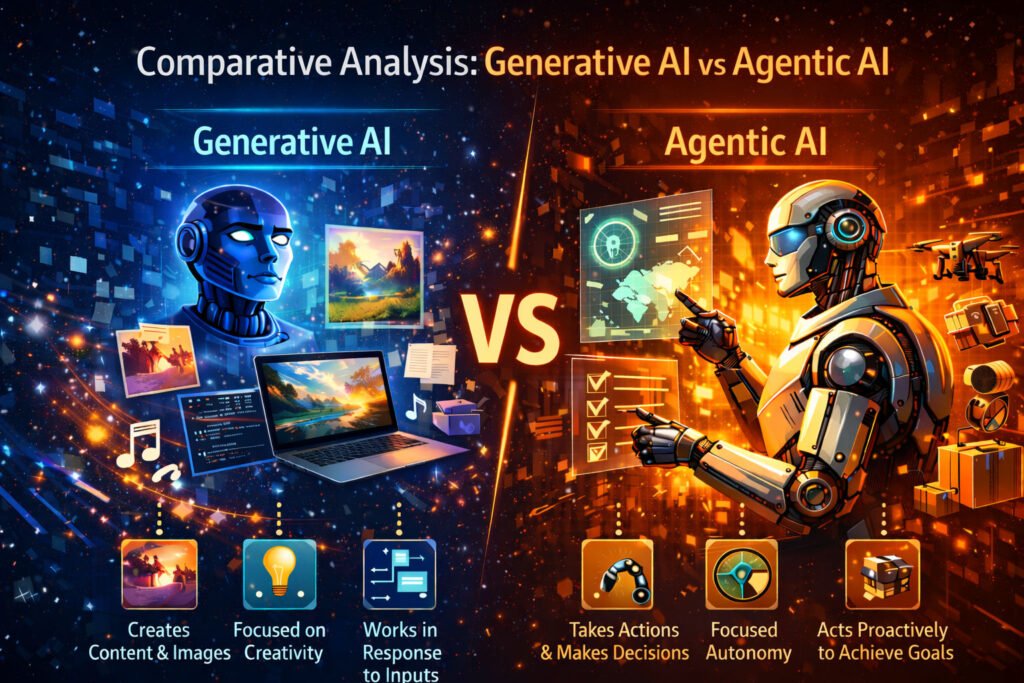
When comparing Generative AI and Agentic AI, several contrasts emerge:
Aspect | Generative AI | Agentic AI |
Primary function | Content creation | Goal-driven action |
Autonomy | Low | High |
Interaction | Prompt-based | Continuous |
Environment awareness | Limited | High |
Typical outputs | Text, images, code | Decisions, actions, workflows |
Despite these differences, the two approaches are increasingly combined in modern AI systems.
Applications of Generative AI in Creative Fields
Generative AI plays a major role in creative industries, including:
- Digital art and graphic design
- Content marketing and advertising
- Video game asset creation
- Film pre-visualization and animation
- Music composition and sound design
Its ability to generate diverse outputs quickly has transformed creative workflows.
Applications of Agentic AI in Automation and Decision Making
Agentic AI excels in automation-heavy and decision-centric domains such as:
- Business process automation
- IT operations and monitoring
- Autonomous customer support systems
- Smart manufacturing and logistics
- Strategic planning and optimization
These systems reduce manual effort while improving efficiency and consistency.
Technical Foundations of Generative AI
The technical foundation of Generative AI is based on:
- Large-scale datasets
- High-performance computing (GPUs/TPUs)
- Probability modeling and optimization
- Fine-tuning and alignment techniques
These elements ensure accuracy, fluency, and relevance in generated outputs.
Practical Applications of Agentic AI
In practice, Agentic AI is used to:
- Manage complex workflows across tools
- Monitor systems and respond to incidents
- Coordinate tasks between multiple agents
- Execute long-running objectives autonomously
Such applications demonstrate the operational strength of agent-based systems.
Use Cases of Generative AI
Common use cases of Generative AI include:
- Automated content creation
- Language translation and summarization
- Product description generation
- Personalized learning materials
Rapid prototyping of ideas
Benefits of Agentic AI in Various Industries
Agentic AI provides several benefits across industries:
- Increased operational efficiency
- Reduced human workload
- Faster and more consistent decision-making
- Improved scalability of processes
Enhanced adaptability to changing conditions
Ethical Considerations in Generative AI
Ethical considerations surrounding Generative AI include:
- Data privacy and consent
- Intellectual property concerns
- Bias and fairness in generated content
- Misinformation and content misuse
- Transparency and accountability
Addressing these issues is critical for responsible deployment.
Ethical Implications of Agentic AI
Agentic AI raises additional ethical challenges, such as:
- Accountability for autonomous actions
- Safety in decision-making systems
- Alignment with human values and goals
- Control and oversight of autonomous agents
- Potential over-reliance on automated decisions
Strong governance frameworks are essential to mitigate these risks.
Frequently Asked Questions
1. What is Generative AI?
Generative AI is a type of artificial intelligence that creates new content such as text, images, videos, audio, or code based on user prompts. It works by learning patterns from large datasets and generating responses when asked.
2. What is Agentic AI?
Agentic AI is an AI system designed to autonomously plan, decide, and take actions to achieve specific goals. Unlike Generative AI, it can operate across tools and systems with minimal human intervention.
3. What is the main difference between Generative AI and Agentic AI?
The main difference is functionality. Generative AI focuses on creating content when prompted, while Agentic AI focuses on decision-making and executing tasks autonomously to achieve predefined goals.
4. Is Agentic AI a type of Generative AI?
No. Agentic AI is not a type of Generative AI. However, Agentic AI systems often use Generative AI models as components to generate text, analyze data, or reason while completing tasks.
5. How does Generative AI work?
Generative AI works by predicting the next output based on patterns learned from large datasets. It uses machine learning models, especially neural networks, to generate text, images, or other content when given a prompt.
6. How does Agentic AI work?
Agentic AI works by setting goals, planning steps, evaluating outcomes, and executing actions across systems. It uses reasoning, memory, and feedback loops to adapt and complete multi-step tasks autonomously.
7. Is Generative AI reactive or proactive?
Generative AI is reactive. It responds only when a user provides a prompt and does not initiate actions or make decisions independently.
8. Is Agentic AI proactive?
Yes. Agentic AI is proactive because it can initiate actions, make decisions, and adapt its behavior based on changing conditions without constant user input.
9. What are common examples of Generative AI?
Common examples of Generative AI include chatbots, AI image generators, code generators, content-writing tools, and video generation platforms used for creative and productivity tasks.
10. What are common examples of Agentic AI?
Examples of Agentic AI include autonomous workflow systems, AI security agents, IT automation bots, self-managing customer support agents, and decision-making systems in enterprises.
11. Which AI is better for content creation?
Generative AI is better for content creation because it specializes in producing text, images, videos, and other creative outputs based on user instructions.
12. Which AI is better for automation?
Agentic AI is better for automation because it can plan tasks, interact with multiple tools, and complete workflows independently without continuous human involvement.
13. Can Generative AI take actions on its own?
No. Generative AI cannot take actions independently. It only generates outputs when prompted and does not execute tasks or make decisions autonomously.
14. Can Agentic AI work without human supervision?
Agentic AI can operate with limited human supervision but still requires oversight, especially in sensitive or high-risk environments, to ensure safety and correctness.
15. Does Agentic AI replace Generative AI?
No. Agentic AI does not replace Generative AI. Instead, it builds on Generative AI by adding planning, memory, and execution capabilities.
16. What are the business benefits of Generative AI?
Generative AI helps businesses improve productivity, reduce content creation time, enhance creativity, and support tasks like marketing, documentation, and software development.
17. What are the business benefits of Agentic AI?
Agentic AI enables end-to-end automation, faster decision-making, reduced operational costs, and improved efficiency by handling complex workflows autonomously.
18. Which AI is more complex to implement?
Agentic AI is more complex to implement because it requires system integrations, governance, monitoring, and clear goal definitions, unlike Generative AI which is easier to deploy.
19. Is Agentic AI riskier than Generative AI?
Yes. Agentic AI carries higher risks due to its autonomous nature, including unintended actions or system errors, making strong governance and monitoring essential.
20. Can both Generative AI and Agentic AI be used together?
Yes. Many modern AI systems combine Generative AI for content and reasoning with Agentic AI for planning and execution, creating powerful hybrid solutions.
21. Which AI is better for beginners?
Generative AI is better for beginners because it is easy to use, prompt-based, and requires minimal technical knowledge compared to Agentic AI.
22. What industries use Generative AI the most?
Generative AI is widely used in marketing, education, software development, media, healthcare, and customer support for content and knowledge generation.
23. What industries benefit most from Agentic AI?
Agentic AI is most useful in enterprise IT, cybersecurity, finance, logistics, operations, and customer service automation where complex workflows are required.
24. Is Agentic AI the future of artificial intelligence?
Agentic AI represents the next evolution of AI by enabling autonomous decision-making and action, but it will coexist with Generative AI rather than replace it.
25. Which AI should businesses choose: Generative or Agentic?
Businesses should choose Generative AI for creativity and content tasks, and Agentic AI for automation and decision-driven workflows. Many organizations benefit from using both together.