Introduction to Generative AI
Artificial Intelligence has been steadily evolving for decades, but the real breakthrough moment arrived with Generative AI. At its core, Generative AI refers to systems that don’t just analyze or classify data—they create. Whether it’s generating a new piece of music, producing realistic human-like text, designing innovative product prototypes, or even crafting synthetic medical data for safe research, Generative AI has opened doors to a new era of machine creativity.
An Introduction to Generative AI is important because it helps us understand why this technology is not just a buzzword but a paradigm shift. Unlike traditional AI models, which primarily consume data to make predictions, generative systems produce entirely new outputs that mimic human imagination. This makes them particularly valuable in industries where originality and scalability are equally important. For example:
- Content Creation: AI models like GPT can write blogs, stories, and social media posts at scale.
- Design and Art: Tools like DALL·E and MidJourney create compelling visuals and artwork.
- Healthcare: Generating synthetic datasets allows medical research without risking patient privacy.
- Software Development: Code generators accelerate programming tasks and reduce human error.
- Education & Training: Personalized, AI-generated learning paths adapt to student needs.
NEW BLOG : PYTHON PROGRAMMING IN GENERATIVE AI
- Another major factor that makes the Introduction to Generative AI so important today is its growing accessibility. Until a few years ago, only large corporations and research institutions could afford the computing power required for such models. Now, cloud platforms and open-source communities have made these tools available to startups, educators, and individual creators.
In simple terms, Generative AI is the bridge between automation and imagination. It enables machines not only to follow instructions but also to contribute original ideas. By studying an Introduction to Generative AI, learners and professionals gain insight into how these systems are trained, what makes them effective, and how they can be applied responsibly in real-world scenarios.
Ultimately, this section sets the stage for deeper discussions—control structures, model training, and best practices—because creativity without control can quickly become noise. That’s why any Introduction to Generative AI must balance excitement with an understanding of how to guide and refine these models.
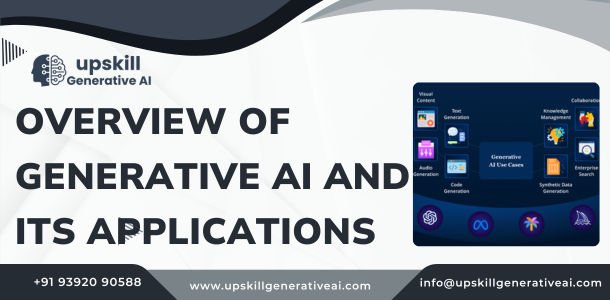
When we talk about an Introduction to Generative AI, it is impossible to ignore its vast scope of applications. Generative AI has moved from research labs into mainstream industries, redefining how we create, consume, and optimize information. Unlike traditional AI that classifies or predicts outcomes, generative systems go a step further—they invent new patterns, data, and solutions that mimic human creativity.
Key Industry Applications
- Healthcare and Life Sciences
- Generating synthetic medical records that protect patient privacy while helping researchers train models.
- Drug discovery: AI simulates molecular structures, dramatically reducing the time and cost of developing medicines.
- Medical imaging: Generative models can enhance scans, remove noise, and even generate 3D visualizations of organs.
- Generating synthetic medical records that protect patient privacy while helping researchers train models.
- Education and E-Learning
- Personalized lesson plans designed to adapt to every learner’s pace.
- AI-powered tutors that adapt explanations and examples in real time.
- Creation of training datasets and practice material at scale.
- Personalized lesson plans designed to adapt to every learner’s pace.
- Entertainment and Media
- Script generation for films, ads, and gaming storylines.
- AI-composed music and artwork tailored for specific moods or audiences.
- Virtual reality worlds populated by AI-generated objects and characters.
- Script generation for films, ads, and gaming storylines.
- Business and Marketing
- Automated content creation: blog drafts, ad copies, product descriptions.
- Hyper-personalized marketing campaigns that adjust tone and visuals for each customer.
- Market trend simulations to predict consumer behavior.
- Automated content creation: blog drafts, ad copies, product descriptions.
- Software Development & IT
- AI-generated code snippets that reduce development time.
- Test case generation for QA automation.
- Cloud-based AI services providing instant data pipelines or ETL (Extract, Transform, Load) flows.
- AI-generated code snippets that reduce development time.
- Creative Industries
- Fashion design powered by AI-suggested color palettes and patterns.
- Architecture visualization, generating lifelike models before construction.
- AI-assisted writing in journalism, blogging, and publishing.
- Fashion design powered by AI-suggested color palettes and patterns.
Broader Benefits
- Speed and Efficiency: Tasks that once required days (e.g., drafting product manuals) can now be completed in hours.
- Generative AI enables limitless content creation, giving businesses an infinite pool of creative possibilities.
- Cost Reduction: Automation reduces manual workload and dependency on large teams.
- Innovation Catalyst: It fuels ideas humans may not think of, opening doors to breakthrough inventions.
An Introduction to Generative AI reveals that its true power lies not only in creating impressive visuals or text but in redesigning how entire workflows function. From a student writing an essay to a multinational corporation designing its next product, generative AI offers tools that are faster, more scalable, and more intelligent than anything before.
Understanding Control Structures in AI
When exploring the Introduction to Generative AI, one of the most overlooked yet critical concepts is control structures. In traditional programming, control structures determine the flow of execution—think of conditionals (if–else), loops (for, while), or branching decisions. These structures allow programmers to guide logic, maintain order, and handle complex instructions.
In AI, the principle is similar but applied on a larger and more dynamic scale. Control structures in Generative AI are the guiding mechanisms that dictate how a model generates, refines, and evaluates content. They provide balance between creativity and reliability—without them, outputs could become unpredictable, biased, or irrelevant.
Why Control Structures Matter in Generative AI
- Predictability in Outputs – Generative models, especially large language models, can produce endless variations of text, images, or music. Control structures ensure that the outputs align with user intent and stay within contextual limits.
- Ethical Safeguards – Without structured controls, AI systems might generate harmful, biased, or offensive results. Guardrails (a form of control structure) prevent such risks.
- Efficiency in Training – Control mechanisms optimize when to stop training, how to handle errors, and when to adjust hyperparameters. This avoids wasted computational resources.
- User-Centric Customization – Control structures allow models to adapt to specific prompts, industries, or domains—whether it’s healthcare, finance, or education.
Examples of Control Structures in Practice
- Chatbots: A conversational AI doesn’t just answer randomly; branching control structures ensure it follows dialogue rules, remembers context, and maintains coherence.
- Image Generation Models: In diffusion-based systems, iterative loops remove noise step by step until a clear, realistic image emerges.
- Music Composition AI: Conditional controls ensure rhythm, tempo, and harmony remain consistent even as new melodies are generated.
- Reinforcement Learning Agents: Feedback-driven loops tell the system whether an action leads closer to or further from the goal.
The Link Between Control Structures and Trust
For businesses adopting AI, trust is everything. An Introduction to Generative AI without strong control structures risks producing outputs that are unverified, misleading, or misaligned with brand values. By embedding layered controls—such as prompt filtering, ethical guidelines, and human oversight—organizations build confidence in both the technology and its outcomes.
When exploring an Introduction to Generative AI, one of the most important areas to understand is the role of control structures. These mechanisms give order to the creative chaos of AI models. Without them, a model might generate outputs endlessly, stray from the desired topic, or even produce harmful results. Below are the most common and impactful types of control structures in Generative AI:
1. Conditional Control Structures
Conditional structures act like decision gates. They ensure that outputs match the prompts or contextual requirements.
- Example in Text Models: A prompt such as “Write a poem in the style of Shakespeare” makes the model branch into Shakespearean phrasing instead of modern English.
- Example in Image Models: A diffusion model can be conditioned on text so that “generate a cat on Mars” produces not just any cat, but one specifically in a Martian landscape.
By applying conditional control structures in Generative AI, developers can align outputs closely with user intent.
2. Iterative Looping Mechanisms
Many generative processes require repeated refinements, and this is where looping structures come in.
- Diffusion Models: They start with noise and gradually refine the image over dozens or even hundreds of steps.
- GAN Training: Generators and discriminators engage in multiple iterative loops until equilibrium is reached.
Looping ensures that raw outputs evolve into polished results. In any Introduction to Generative AI, loops are compared to sculptors chiseling raw stone until the figure emerges.
3. Branching Structures
Branching structures guide AI to follow different outcomes based on checkpoints..
- Conversational AI: In chatbots, branching determines which dialogue path to follow depending on the user’s query.
- Music Generation: A model may “decide” whether to continue a melody in major or minor key based on prior notes.
This branching makes AI interactive and adaptive, which is crucial for applications like personalized learning systems or adaptive gaming.
4. Feedback-Driven Structures
Feedback structures embed learning signals into the generative process. They can be human-driven or machine-driven.
- Reinforcement Learning with Human Feedback (RLHF): Used in large language models, where human ratings guide the AI toward safer and more relevant responses.
- Self-Correcting Loops: Models that critique their own outputs and make adjustments before finalizing results.
Feedback-based control structures in Generative AI act like a teacher correcting homework—improving quality over time.
5. Constraint-Based Control Mechanisms
Sometimes the model must generate within strict rules—like staying ethical, unbiased, or domain-specific.
- Ethical Guardrails: Blocking offensive or harmful outputs.
- Technical Constraints: Limiting text length, pixel resolution, or vocabulary choices.
- Domain-Specific Rules: A financial model may only generate numbers within valid ranges for stock predictions.
Constraint-based controls are essential to keep Generative AI applications trustworthy and usable in real-world environments.
6. Hybrid Control Structures
In real-world applications, systems often combine multiple control structures rather than relying on just one. Hybrid models combine several controls for balance.
- Example: A text-to-image system may use conditions (prompted descriptions), loops (iterative refinement), and constraints (removing unsafe content) all at once.
- Benefit: Hybrid structures ensure both flexibility and safety.
Hybrid approaches are becoming the industry standard, and every Introduction to Generative AI course now emphasizes them.
7. Emerging Adaptive Controls
Research in Generative AI is pushing toward adaptive control structures—ones that adjust themselves dynamically.
- Meta-Learning: Models that change their own control structures based on new tasks.
- Context-Aware Controls: AI systems that decide how much detail, tone, or creativity to use depending on user profiles.
These adaptive structures represent the next frontier in Generative AI development, where AI doesn’t just generate content but also controls how it generates in a self-regulated manner.
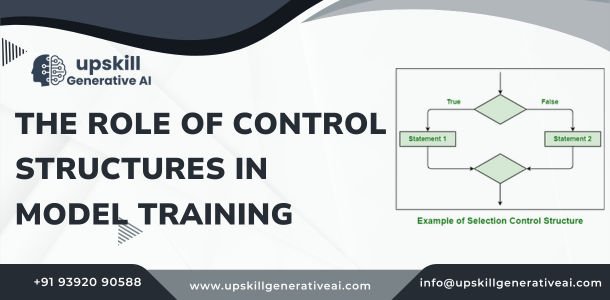
The Role of Control Structures in Model Training
Model training is not just about feeding data into a neural network; it requires rules to avoid chaos. Control structures ensure that training stays aligned with goals.
- Preventing Overfitting: Loops with early stopping act as a safeguard.
- Shaping Behavior: Conditional structures fine-tune how a model responds to prompts.
- Managing Resources: Control mechanisms optimize GPU/TPU usage during iterative runs.
- Improving Accuracy: Feedback loops improve predictive quality with every cycle.
From an Introduction to Generative AI perspective, this means the “creative” part of AI is never uncontrolled—it is always tethered to training logic.
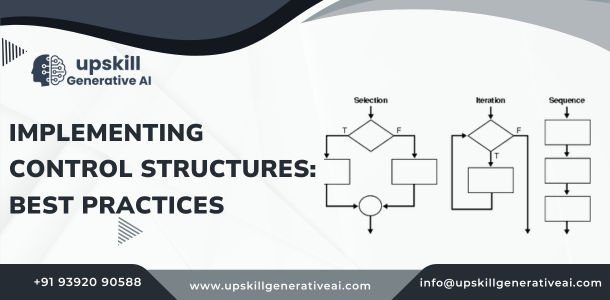
Implementing Control Structures: Best Practices
Implementing control structures in Generative AI is not just about coding logic—it is about designing systems that are safe, efficient, and aligned with human goals. Without well-defined practices, even the most powerful models risk generating irrelevant, biased, or unsafe content. The following best practices ensure that control structures guide creativity in the right direction.
1. Prompt Engineering with Guardrails
Prompts are the “instructions” given to AI systems, and they can make or break results. Effective control structures often start here.
- Structured Prompts: Instead of asking “write about animals,” specifying “generate a 300-word informative blog on rainforest animals focusing on biodiversity” provides better control.
- Guardrails: Combining prompts with rule-based checks (like blocking harmful language) ensures AI remains safe and reliable.
- Example: In an Introduction to Generative AI training program, learners are taught to design layered prompts combined with constraints to achieve predictable results.
2. Human-in-the-Loop Systems
No matter how advanced, Generative AI benefits from human supervision. Humans act as quality controllers for outputs.
- Pre-Generation Checks: Humans define limits before generation begins, such as restricting word counts or tone.
- Post-Generation Validation: Reviewers validate whether AI-generated data meets ethical and business standards.
- Practical Use Case: In healthcare AI, doctors validate generated reports to ensure accuracy before clinical use.
3. Feedback Cycles and Human-Guided Reinforcement Learning
Feedback loops are among the strongest forms of control structures.
- Iterative Refinement: Models learn continuously from user corrections and adapt to evolving expectations.
- RLHF Advantage: By ranking AI outputs, humans indirectly teach the system which paths are preferred.
- Example: In conversational bots, RLHF ensures the assistant becomes more aligned with polite, accurate, and context-aware interactions.
4. Constraint-Based Learning
Another best practice is embedding hard constraints into training and inference.
- Ethical Constraints: Limiting content around sensitive topics.
- Technical Constraints: Restricting token length, computation cycles, or memory usage.
- Domain Constraints: Tailoring AI outputs for specific industries such as legal, finance, or education.
This ensures that the Introduction to Generative AI does not just stay theoretical but produces reliable real-world applications.
5. Transparency and Documentation
AI control structures should not be hidden “black boxes.”
- Clear Logs: Every decision path should be logged for audit purposes.
- Training Notes: Document how prompts, loops, and constraints were applied.
- Compliance Readiness: This is critical for industries like finance or healthcare, where regulations require explainability.
6. Scalable Testing and Evaluation
“You need to test a generative model carefully before using it.”
- Stress Testing: Pushing the model to handle edge cases and heavy loads to check how stable and consistent the outputs remain.
- A/B Testing: Comparing results from different control structures to identify the most effective approach.
- Metric-Driven Monitoring: Tracking accuracy, diversity, and ethical alignment ensures AI scales responsibly.
7. Ethical and Cultural Awareness
Generative AI is global, but control structures must adapt to cultural and ethical standards.
- Bias Mitigation: Embedding fairness checks in loops and conditionals.
- Regional Sensitivity: Ensuring content respects cultural values.
Case Study: Social media platforms use AI filters trained with region-specific constraints to avoid offensive or harmful outputs.
Model training is not just about feeding data into a neural network; it requires rules to avoid chaos. Control structures ensure that training stays aligned with goals.
- Preventing Overfitting: Loops with early stopping act as a safeguard.
- Shaping Behavior: Conditional structures fine-tune how a model responds to prompts.
- Managing Resources: Control mechanisms optimize GPU/TPU usage during iterative runs.
- Improving Accuracy: Feedback loops improve predictive quality with every cycle.
From an Introduction to Generative AI perspective, this means the “creative” part of AI is never uncontrolled—it is always tethered to training logic.
Frequently Asked Questions on Generative AI
What is the introduction of Generative AI? +
Generative AI is a branch of AI that produces new content—text, images, music, video, or code—by learning patterns from large datasets. Examples include ChatGPT and DALL·E.
In what ways does ChatGPT differ from Generative AI? +
Generative AI is a broad discipline that creates many content types (text, images, video, music). ChatGPT is a specific application focused on natural language understanding and conversational responses.
What is the difference between ChatGPT and Generative AI? +
Generative AI spans multiple modalities (text, images, video, music), while ChatGPT is a language-first tool built to generate conversational text.
How many Generative AI tools are there? +
There are hundreds, and the ecosystem is growing quickly. Key categories include:
- Text: ChatGPT, Jasper, Copy.ai
- Images: Midjourney, DALL·E, Stable Diffusion
- Video: Synthesia, Runway
- Music & audio: AIVA, Soundraw
What are the four types of Generative AI? +
- GANs: Image/video generation
- VAEs: Synthetic data & reconstruction
- Transformers: Text/language & multimodal (e.g., ChatGPT, BERT)
- Diffusion models: High-quality image generation (e.g., Stable Diffusion, Midjourney)
What are the pros and cons of Generative AI? +
Advantages
- Boosts productivity via automated content creation
- Enables personalization in education, marketing, and support
- Creates realistic simulations for healthcare, design, and research
Disadvantages
- Potential bias and misinformation
- Higher cost and energy usage at scale
- Ethical concerns: copyright, originality, misuse
What is the biggest problem with Generative AI? +
The most pressing issue is bias and misinformation: models can reproduce harmful or inaccurate patterns from their training data.
What is the biggest risk of using Generative AI? +
Misuse—for example, deepfakes, disinformation, or harmful code. Other risks include job disruption, reduced trust, and privacy concerns.
How much energy does Generative AI use? +
Large models require substantial energy to train and serve. For context, public estimates place training runs in the order of megawatt-hours, with ongoing GPU inference also consuming significant power at scale.
How much does it cost to run Generative AI? +
Costs vary by model size and usage:
- Training: From hundreds of thousands to millions of USD for frontier models.
- Inference: From cents per request to enterprise-scale monthly spend.
- Cloud: GPU hours, storage, and autoscaling largely determine the bill.