Key Concepts in Generative Models
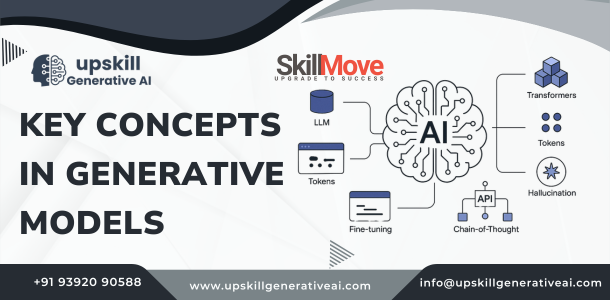
Introduction to Generative Models
Generative AI models leverage techniques like unsupervised learning, allowing them to identify complex patterns in unlabeled data and synthesize realistic, high-quality outputs. These models are trained to learn the joint probability distribution of data, giving them the ability to generate novel samples that are consistent with the training data. This capacity for content creation is fueling innovations across industries, from artistic design to scientific research, positioning generative models as an exciting frontier in AI development.
Key Concepts in Generative Models Topic 1
Types of Generative Models
To understand the diversity of generative approaches, it’s helpful to explore their foundational types, each with unique methodologies:
- Generative Adversarial Networks (GANs): Consisting of a generator and discriminator that compete during training, GANs produce remarkably realistic images and videos by refining their output through this adversarial process. GANs are particularly popular for creating hyper-realistic visual content, deepfake videos, and art generation.
- Variational Autoencoders (VAEs): By compressing data into a latent space and then reconstructing it, VAEs learn to generate new data samples through sampling and decoding from this learned feature space. They are widely used in image editing, anomaly detection, and data augmentation.
- Autoregressive Models: Generating data sequentially, these models predict each next element based on previously generated data. Notable examples include language models like GPT, which are used extensively in NLP tasks such as text completion, translation, and summarization.
- Flow-based Models: These models use invertible neural networks to learn exact likelihoods of data, enabling efficient sampling and precise density estimation. They are especially useful in applications requiring high fidelity and expressiveness in data synthesis.
- Diffusion Models: Widely used in image synthesis, diffusion models start with noise and gradually refine the noise into a coherent image or data sample by reversing a noising process. They are gaining popularity for their ability to produce high-quality, detailed visuals.
Together, these models serve as the backbone for cutting-edge applications across multimedia creation, data science, and AI-driven research, pushing the boundaries of what machines can generate and simulate.
NEW BLOG : PYTHON PROGRAMMING IN GENERATIVE AI
Key Concepts in Generative Models Topic 2
Key Algorithms in Generative AI
Generative AI relies on several cutting-edge algorithms that enable machines to learn complex data distributions and create authentic new content:
- Generative Adversarial Networks (GANs): These utilize a game-theoretical setup where a generator network creates synthetic data samples, and a discriminator network evaluates their authenticity. Through this adversarial process, the generator progressively improves, resulting in highly realistic data generation such as images and videos.
- Transformer-based Models: Popularized by models like GPT (Generative Pre-trained Transformer), transformers use self-attention mechanisms to capture the context and relationships within sequential data. This allows them to generate coherent, context-aware text by predicting the next token based on previously generated tokens. They are the backbone of many modern NLP applications.
- Diffusion Algorithms: These models generate data by starting with random noise and gradually denoising it through learned iterative steps to form coherent and detailed outputs. Diffusion models excel at image synthesis, creating high-quality visuals through a controlled reverse-noising process.
- Variational Autoencoders (VAEs): VAEs learn latent variable distributions to encode input data into a compressed space and then decode samples drawn from this space back into new data instances. They are used in scenarios requiring smooth interpolation between generated samples and controllable data generation.
These foundational algorithms typically require training on expansive datasets using extensive computational resources. They work by modeling the underlying probability distributions of the training data, enabling them to generate diverse and high-fidelity content across various media types, including text, images, audio, and video.
Key Concepts in Generative Models Topic 3
Applications of Generative Models
Generative models have transformed multiple industries by enabling the automatic creation of valuable new data:
- Content Creation: Automate writing articles, generating creative artwork, and composing music, making media production more scalable and personalized.
- Image and Video Synthesis: Produce realistic photos, deepfakes, and special effects for entertainment, advertising, and digital art.
- Drug Discovery: Accelerate pharmaceuticals by designing novel molecular structures and predicting chemical behaviors, reducing time and costs in R&D.
- Data Augmentation: Expand limited datasets by generating synthetic samples to improve the robustness and accuracy of AI models.
- Simulation and Gaming: Generate immersive scenarios, characters, and environments for virtual reality and gaming experiences.
Their remarkable ability to generate new, high-quality data that closely mimics real-world examples makes generative models invaluable tools fostering innovation and efficiency across sectors.

Key Concepts in Generative Models Topic 4
Comparison of Generative and Discriminative Models
Generative and discriminative models represent two fundamental approaches in machine learning, each serving distinct purposes and excelling in different scenarios
- Generative Models seek to learn the joint probability distribution of features and labels, P(X,Y)
- P(X,Y). This allows them not only to understand how the data is distributed but also to generate new data samples that resemble the training data. They perform well in unsupervised or semi-supervised learning tasks and are used extensively in creative AI applications like content generation, image synthesis, and anomaly detection. Examples include Generative Adversarial Networks (GANs), Variational Autoencoders (VAEs), and Hidden Markov Models (HMMs).
- Discriminative Models focus on modeling the conditional probability
- P(Y∣X)
- P(Y∣X)
- P(Y∣X)—directly learning the boundary between classes. Their primary goal is classification or prediction based on labeled data, making them highly effective in supervised learning tasks such as image recognition, spam detection, and medical diagnosis. Common discriminative models include Logistic Regression, Support Vector Machines (SVMs), and BERT (a discriminative language model).
A clear example illustrating the difference: a generative model can create new images of dogs by learning their features, while a discriminative model can only classify an image as a dog or cat based on learned boundaries. Some models, like GANs, combine generative and discriminative components, leveraging both approaches to enhance performance.
Key Concepts in Generative Models Topic 5
Key Differences Table
Aspect | Generative Models | Discriminative Models |
Model Focus | Learn full data distribution P(X,Y) P(X,Y) | Learn decision boundary $$ P(Y |
Purpose | Generate new data samples | Classify or predict labels |
Training Data | Can work with unlabeled or partially labeled data | Require labeled data |
Use Cases | Content creation, data augmentation, anomaly detection | Image classification, spam filtering, sentiment analysis |
Complexity | Usually more complex due to broader learning task | Generally simpler and faster to train |
Examples | GANs, VAEs, Hidden Markov Models | Logistic Regression, SVM, BERT |
Choosing between generative and discriminative models depends on the specific application. For tasks requiring creative content generation or modeling data distributions, generative models are preferred. For tasks demanding accurate classification and prediction, discriminative models usually perform better and are more efficient.
More Articles Like This
Frequently Asked Questions on Generative Models
What are generative models in AI?
Generative models are AI systems that learn data patterns and generate new, realistic samples—such as text, images, or audio—that closely resemble their training data.
How do generative and discriminative models differ?
Generative models learn the overall data distribution and can produce new examples, while discriminative models focus on classifying existing data by learning the boundaries between classes.
What are the main types of generative models?
- Key types include:
- GANs (Generative Adversarial Networks): Use adversarial training to create realistic content.
- VAEs (Variational Autoencoders): Rely on latent-space sampling to synthesize new data.
- Autoregressive models: Generate sequences like language or music.
- Flow-based models: Use reversible transformations for exact likelihood estimation.
- Diffusion models: Build outputs by incrementally denoising random noise.
How are generative AI models used in real-world applications?
They power content creation, image and video synthesis, molecule design for drug discovery, data augmentation, simulation environments, and digital art.
Why have diffusion models become popular by 2025?
Diffusion models excel in generating detailed visuals by refining noise, and their stability, controllability, and accessible open-source tools have made them the go-to option for AI-driven art and design.
How do GANs function?
GANs consist of a generator that creates synthetic data and a discriminator that identifies fakes, with both networks improving together through competitive training until generated samples resemble real data.
What skills are important for working with generative AI?
Crucial skills include Python programming, deep learning with TensorFlow or PyTorch, knowledge of probability and statistics, understanding neural networks, and experience with GPU-based training.
What is the future scope of generative models?
These models are set to transform industries through personalized media, AI creativity, scientific research, drug development, and automation, becoming foundational technologies in digital innovation.
How are generative models trained?
Generative models learn data patterns by processing large datasets, using techniques like unsupervised or self-supervised learning. Training involves minimizing loss functions such as reconstruction loss for VAEs or adversarial loss for GANs.
Can generative AI work with unlabeled data?
Yes, generative models often excel with unlabeled or partially labeled data. They focus on learning underlying data structures rather than specific labels.
What ethical issues are linked to generative AI?
Major concerns include deepfakes, copyright violations, misinformation, and bias. Responsible use, watermarking, and strong AI governance help address these risks.
Which generative AI models generate text?
Autoregressive and transformer-based models, such as GPT, LLaMA, and BERT variants, lead in text generation by predicting each word or token step-by-step.
Which industries benefit most from generative AI?
- Key sectors include:
- Entertainment: movies, music, gaming
- Healthcare: drug discovery, imaging
- Finance: fraud detection, data generation
- E-commerce: recommendations, product design
- Education: AI tutors, automated content
How are diffusion models different from GANs?
GANs use two competing networks, while diffusion models build outputs by gradually removing noise. Diffusion models tend to create higher-quality, more stable results, but are slower than GANs.
Are VAEs the same as autoencoders?
No. VAEs are probabilistic and generate diverse samples by learning latent distributions, while autoencoders simply compress and reconstruct input data.
How do generative models help with data augmentation?
They synthesize realistic new samples to expand training datasets, which is vital when real data is limited or sensitive, such as in healthcare or fraud detection.
What is latent space in generative models?
Latent space is a compressed, mathematical representation of essential data features. Sampling from it allows the creation of new outputs resembling real examples.
Which open-source tools support generative models?
Leading options are TensorFlow, PyTorch, Hugging Face Transformers, Diffusers, RunwayML, and ComfyUI.
Can generative models be used for anomaly detection?
Yes. By learning what’s normal in data, these models can highlight unusual or suspicious inputs, useful for fraud or defect detection.
What challenges arise in training generative models?
Key issues include mode collapse in GANs, high resource requirements, unstable training, and difficulties in objectively measuring the quality of generated output