Prompt Engineering Tools
A Complete Guide for Beginners and Professionals
Prompt engineering tools are becoming essential in today’s AI driven world. Whether you are a student, content creator, marketer, developer, or business owner, knowing how to use the right prompt engineering tools can significantly improve the quality, accuracy, and efficiency of AI generated outputs.
This guide explores what prompt engineering tools are, why they matter, the best tools available today, and how to choose the right one for your needs.
Introduction to Prompt Engineering Tools
Prompt engineering tools help users design, test, refine, and optimize prompts used with artificial intelligence models. A prompt is simply the instruction you give an AI system to generate text, images, code, or other outputs.
Good prompts lead to:
- More accurate responses
- Better creativity
- Faster task completion
- Reduced trial and error
As AI adoption grows, prompt engineering tools play a crucial role in bridging the gap between human intent and machine understanding.
Why Prompt Engineering Tools Are Important
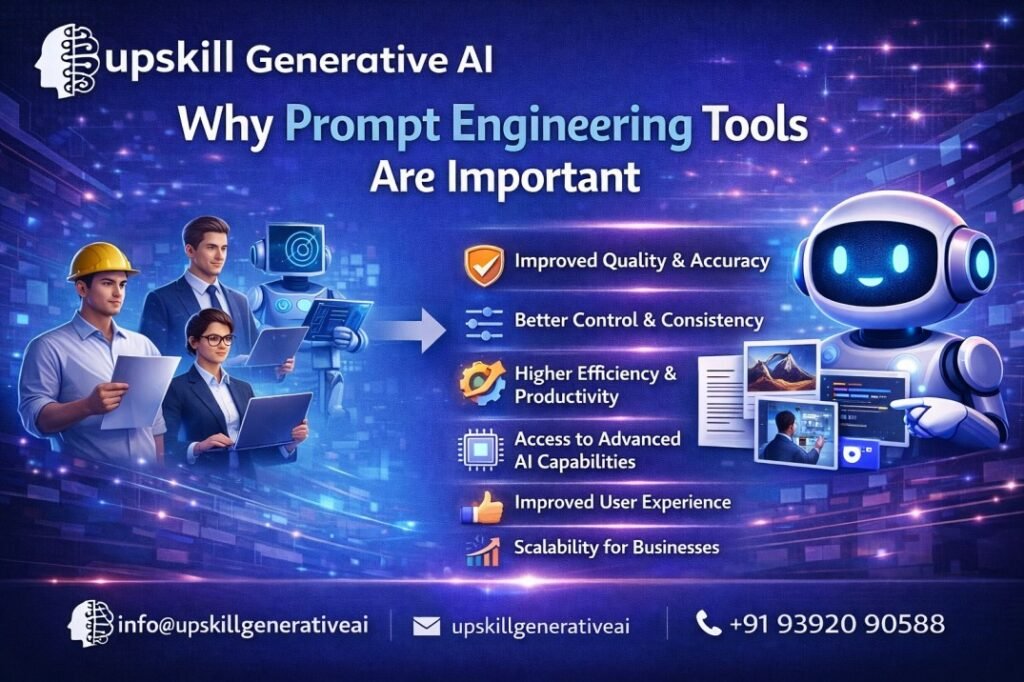
Prompt engineering tools are important because they turn unclear or broad AI requests into clear, structured, and actionable instructions. Instead of relying on guesswork or repeated trial and error, these tools help users communicate their intent precisely, resulting in higher quality and more reliable AI outputs.
One of the biggest advantages of prompt engineering tools is improved accuracy and relevance. By guiding users to frame detailed prompts, these tools reduce AI hallucinations where models generate incorrect or fabricated information and encourage more factual, focused responses. This is especially valuable in areas like content creation, research, coding, and data analysis.
Prompt engineering tools also provide greater control and consistency. Users can define tone, style, format, and structure such as requesting outputs in JSON, reports, summaries, or step by step explanations. This ensures that results meet exact requirements every time, which is critical for business workflows and professional use cases.
Another key benefit is efficiency. Well crafted prompts allow AI to deliver usable outputs on the first attempt, saving time and effort. Tasks that once took hours like writing long form content, generating code, or analyzing information can now be completed in minutes, accelerating productivity and streamlining workflows.
These tools also unlock advanced AI capabilities. Techniques such as Chain of Thought prompting enable AI models to reason step by step, making them more dependable for complex problem solving, logical analysis, and decision making tasks even for users without deep technical or programming knowledge.
From a user experience perspective, prompt engineering tools make AI more accessible. Beginners and non technical users can achieve advanced outcomes without frustration, while experienced professionals can scale their work faster and more reliably.
For businesses, prompt engineering tools enable scalability and consistency. Organizations can use AI for personalized marketing, customer support, reporting, and data insights at scale improving return on investment, maintaining brand voice, and driving innovation.
Top Prompt Engineering Tools Available Today
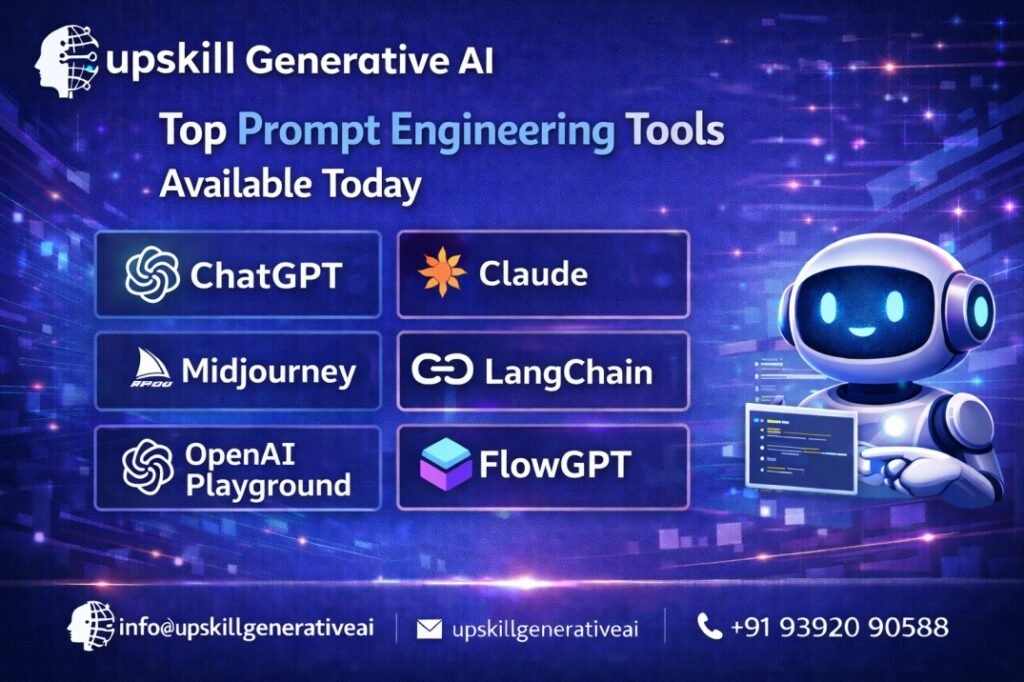
The rapid growth of AI has led to the emergence of powerful prompt engineering tools that help users create precise, reusable, and high performing prompts. These tools are designed to improve output quality, reduce trial and error, and unlock advanced AI capabilities across different use cases such as writing, coding, design, and data analysis.
Below are some of the most widely used and effective prompt engineering tools available today.
Here are some of the most popular and effective prompt engineering tools used today:
ChatGPT
ChatGPT is one of the most popular prompt engineering tools for text based AI interactions. It allows users to experiment with prompt phrasing, refine instructions, and test multiple variations in real time.
Key strengths:
- Excellent for learning prompt structures
- Supports content writing, SEO, coding, and brainstorming
- Enables step by step reasoning and role based prompts
Best suited for:
Content creators, marketers, students, developers, and beginners learning prompt engineering.
Claude
Claude is known for handling long, complex prompts with clarity and safety. It excels at structured reasoning, document analysis, and thoughtful responses, making it a strong prompt engineering tool for professional use.
Key strengths:
- Handles long context prompts effectively
- Produces clear, well structured outputs
- Strong focus on ethical and reliable AI responses
Best suited for:
Researchers, analysts, educators, and business professionals.
Midjourney
Midjourney is a leading prompt engineering tool for AI image generation. The quality of visuals heavily depends on how detailed and descriptive the prompt is, making prompt engineering essential.
Key strengths:
- Supports style, lighting, camera angle, and mood control
- Produces high quality creative visuals
- Encourages advanced prompt experimentation
Best suited for:
Designers, marketers, content creators, and branding professionals.
PromptHero
PromptHero is a dedicated prompt library where users can discover, learn, and reuse high performing prompts across multiple AI platforms.
Key strengths:
- Large collection of tested prompts
- Easy learning for beginners
- Covers text, image, and code prompts
Best suited for:
Beginners, learners, and professionals looking for inspiration and proven prompt formats.
FlowGPT
FlowGPT is a community driven platform that allows users to share and explore prompts built for real world productivity and automation.
Key strengths:
- Community tested prompt ideas
- Covers business, coding, marketing, and automation
- Encourages experimentation and innovation
Best suited for:
Prompt engineers, developers, and productivity focused users.
LangChain
LangChain is an advanced prompt engineering framework used to build applications powered by large language models. It enables structured prompts, chains of reasoning, and AI workflows.
Key strengths:
- Supports Chain of Thought prompting
- Ideal for building AI powered applications
- Enables tool based and multi step prompts
Best suited for:
Developers, AI engineers, and startups building scalable AI solutions.
OpenAI Playground
The OpenAI Playground allows users to test prompts with fine grained control over parameters such as temperature, tokens, and response style.
Key strengths:
- Real time prompt experimentation
- Fine control over AI behavior
- Ideal for testing and optimization
Best suited for:
Advanced users, prompt engineers, and researchers.
Key Features to Look for in Prompt Engineering Tools
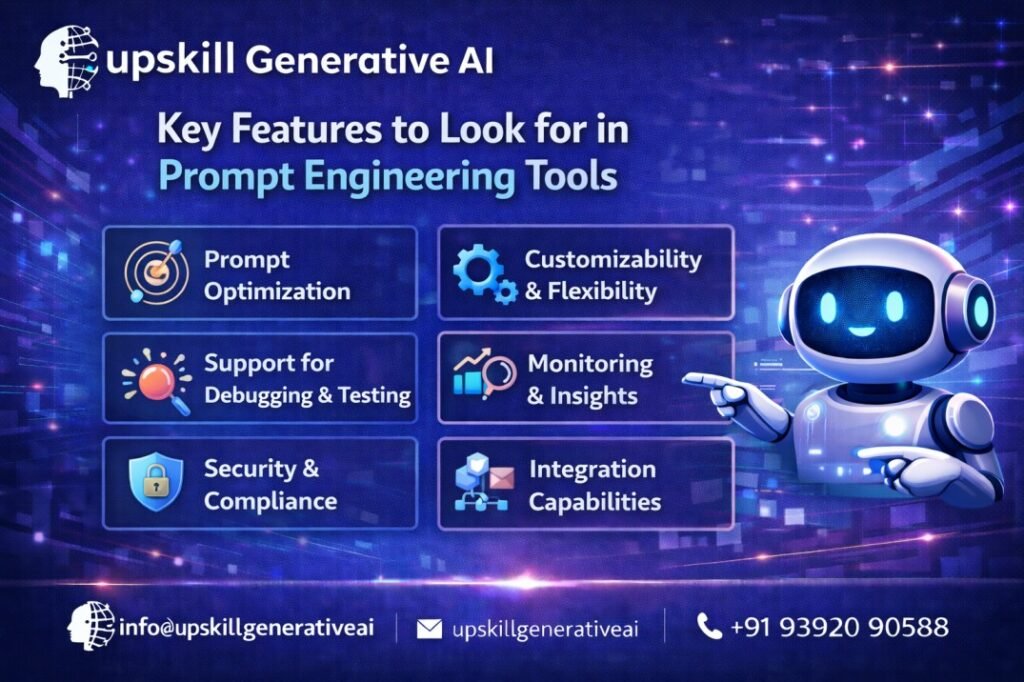
When selecting prompt engineering tools, focusing on the right features ensures better AI outputs, smoother workflows, and long term usability.
- Prompt Templates & Libraries
Ready made templates for common use cases like blog writing, SEO, coding, marketing, data analysis, and customer support help users get started quickly and avoid reinventing prompts. - Prompt Iteration & Refinement Support
The ability to test, modify, and compare multiple prompt versions helps improve accuracy and output quality through experimentation. - Output Formatting Control
Tools should allow users to specify output formats such as JSON, tables, reports, bullet points, summaries, or step by step explanations for professional and technical needs. - Multi Model Compatibility
Support for multiple AI models enables flexibility, allowing users to choose the best performing model for different tasks without switching platforms. - Ease of Use for Beginners
A clean interface, guided inputs, and clear examples make prompt engineering tools accessible even for non technical users. - Advanced Prompt Techniques Support
Features that support methods like Chain of Thought, role based prompting, and context layering help unlock advanced reasoning and problem solving capabilities. - Collaboration & Sharing Options
Team based features such as shared prompt libraries, version control, and collaboration improve consistency across departments and projects. - Customization & Reusability
Saving, tagging, and reusing high performing prompts allows users to build a personal or organizational prompt system. - Performance & Output Consistency
Reliable tools should deliver consistent results across repeated runs, which is critical for business and automation use cases. - Integration with Workflows
Compatibility with tools like content management systems, analytics platforms, or development environments enhances productivity and automation.
How to Choose the Right Prompt Engineering Tool
Choosing the right prompt engineering tool depends on your goals, skill level, and the type of tasks you want to accomplish. Not all tools are built for the same purpose, so understanding your needs is the first step.
- Identify Your Primary Use Case
Decide what you mainly want to use the tool for content writing, SEO, coding, data analysis, image generation, automation, or business workflows. Some tools are better suited for creative tasks, while others focus on structured or analytical outputs. - Consider Your Skill Level
If you are a beginner or non-technical user, choose a tool with ready-made prompt templates and an easy interface. Advanced users may prefer tools that allow deep customization, multi-step reasoning, and prompt chaining. - Check Output Control Options
A good prompt engineering tool should let you control tone, style, length, and format. Look for tools that support structured outputs like JSON, tables, summaries, or step-by-step explanations, especially for professional or business use. - Evaluate Prompt Testing and Iteration Features
The best tools allow you to test multiple prompt variations and refine them easily. This helps you compare outputs and identify which prompts perform best for consistent results. - Look for Reusability and Prompt Libraries
Tools that allow saving, reusing, or sharing prompts are ideal for long-term productivity. Prompt libraries and templates reduce repetitive work and help maintain consistency across projects or teams. - Assess Integration and Scalability
If you plan to use AI at scale, choose a tool that integrates well with other platforms such as content management systems, marketing tools, or internal workflows. This is especially important for businesses and agencies. - Balance Cost and Value
Free tools are good for learning, but paid tools often offer better performance, reliability, and advanced features. Choose a tool that provides clear value for your budget and long-term goals. - Test Before Committing
Whenever possible, try the tool with real tasks. A short trial can reveal whether it truly fits your workflow and delivers the quality you expect.

CLICK HERE >>> GENERATIVE AI TRAINING IN HYDERABAD
Best Practices for Using Prompt Engineering Tools
To get the best results from prompt engineering tools in 2025, it’s no longer enough to write simple instructions. High-quality outputs now depend on a mix of clear prompting fundamentals, structured workflows, and security-aware practices. Whether you are using no-code interfaces or advanced development frameworks, the following best practices will help you consistently achieve better outcomes.
Write Clear, Specific, and Goal-Oriented Prompts
One of the most important rules of prompt engineering tools is clarity. Vague instructions often lead to unpredictable or low-quality outputs.
Instead of asking:
- “Write a blog”
Use:
- “Write a 500-word beginner-friendly blog explaining prompt engineering tools with examples”
Clear prompts reduce confusion and help AI models understand exactly what you want, saving time and iterations.
Structure Prompts Using Delimiters and Sections
Modern prompt engineering tools respond better when instructions are clearly structured. Use delimiters such as:
- ###
- Triple quotes (“””)
- XML-style tags like <context> and <instructions>
This separation helps the model distinguish between background information and actual tasks, leading to more accurate responses.
Use Examples with Few-Shot Prompting
Few-shot prompting is a powerful technique where you show the model what the final output should look like.
By providing 3–5 short examples of:
- Tone
- Format
- Style
You significantly improve consistency and reduce errors. Prompt engineering tools perform better when shown patterns instead of only being instructed verbally.
Encourage Step-by-Step Thinking
For complex tasks such as reasoning, calculations, planning, or decision-making, ask the model to work step by step.
For example:
- “Explain your reasoning step by step, then provide the final answer.”
This approach improves accuracy, especially in logic-heavy or multi-layered tasks, and is widely used in professional prompt workflows.
Assign Clear Roles and Personas
Defining a role helps control the tone, depth, and expertise level of the response.
Examples:
- “You are a senior SEO consultant”
- “You are a beginner-friendly AI tutor”
- “Explain this like a product manager speaking to non-technical users.”
Prompt engineering tools generate more relevant and human-like responses when a clear persona is assigned.
Iterate, Test, and Version Your Prompts
Prompt engineering is an iterative process. High-performing prompts are usually refined over time through testing.
Best practices include:
- Saving prompt versions
- Testing variations with the same input
- Measuring output quality and consistency
This approach helps teams improve results systematically rather than relying on guesswork.
CLICK HERE >>> MLOPS TRAINING IN HYDERABAD
Optimize Model Settings for Better Results
Most prompt engineering tools allow you to adjust parameters that directly affect output quality:
- Temperature
- Low (0–0.2): factual, analytical tasks
- High (0.7+): creative writing, brainstorming
- Low (0–0.2): factual, analytical tasks
- Stop Sequences
- Define where the AI should stop generating text
- Helps control output length and reduces token usage
- Define where the AI should stop generating text
Proper tuning ensures outputs match your exact needs.
Protect Against Prompt Injection and Misuse
Security is becoming a critical part of prompt engineering tools.
Best practices include:
- Clearly instructing models to ignore hidden or conflicting user commands
- Restricting outputs to specific tasks only
- Validating user inputs before passing them to the model
These steps reduce the risk of prompt hijacking and unintended behavior.
Handle Sensitive Data Carefully
Never pass raw personal or confidential data into public prompt engineering tools.
Instead:
- Mask names and identifiers
- Replace real data with placeholders
- Use anonymized or pseudonymized inputs
This protects privacy and ensures compliance with data protection standards.
Break Complex Tasks into Smaller Prompts
Large, multi-step requests can overwhelm AI models. A better approach is task decomposition.
For example:
- Ask for an outline
- Generate each section separately
- Review and refine the final output
This improves focus, accuracy, and overall quality.
CLICK HERE >>>PROMPT ENGINEERING COURSE IN HYDERABAD
Use Retrieval-Augmented Generation (RAG) When Needed
To keep outputs up-to-date and accurate, advanced prompt engineering tools often connect to external data sources.
By combining prompts with:
- Company documents
- Knowledge bases
- Live databases
You provide fresh context that the AI model may not have learned during training.
Encourage Self-Review and Quality Checks
A simple but powerful technique is to ask the model to review its own output.
Examples:
- “Check this answer for logical consistency”
- “Improve clarity and remove repetition”
- “Verify facts before finalizing”
This self-correction step can significantly improve final content quality.
Final Tip: Treat Prompting as a Skill, Not a Shortcut
Prompt engineering tools are most effective when used thoughtfully. The best results come from:
- Practice
- Experimentation
- Structured thinking
As AI continues to evolve in 2025, mastering these best practices will give you a strong advantage in content creation, automation, development, and decision-making.
CLICK HERE >>> AGENTIC AI TRAINING IN HYDERABAD
Prompt Engineering Tools for SEO and Content Creation
Prompt engineering tools have become a powerful asset for SEO professionals, bloggers, digital marketers, and content strategists. When used correctly, these tools help bridge the gap between search intent, content quality, and scalability, making it easier to create content that both users and search engines love.
Keyword Research and Search Intent Mapping
Prompt engineering tools can significantly speed up keyword research and intent analysis. Instead of manually sorting keywords, you can prompt AI to:
- Group keywords by informational, navigational, and transactional intent
- Identify long-tail keyword opportunities
- Suggest semantic keywords and related terms
- Map keywords to blog sections or content clusters
Example prompt idea:
“Analyze the keyword ‘prompt engineering tools’ and generate related long-tail keywords grouped by search intent.”
This helps create content that aligns closely with what users are actually searching for.
SEO-Optimized Content Outlines and Structures
One of the biggest advantages of prompt engineering tools is their ability to generate SEO-friendly content structures.
They can help you:
- Create H1–H6 heading hierarchies
- Ensure logical topic flow
- Cover related subtopics for topical depth
- Avoid keyword cannibalization
By prompting AI to act as an SEO strategist, you can build outlines that are optimized before writing even begins.
High-Quality Blog and Article Writing at Scale
Prompt engineering tools make it possible to generate large volumes of content without sacrificing quality when guided properly.
With well-crafted prompts, you can:
- Maintain a consistent brand tone
- Optimize keyword placement naturally
- Control content length and readability
- Avoid over-optimization and keyword stuffing
Tools like ChatGPT are commonly used for drafting blog posts, guides, and tutorials, especially when prompts clearly define audience, tone, and SEO goals.
Meta Titles, Descriptions, and On-Page SEO Elements
Prompt engineering tools are extremely effective for generating on-page SEO elements such as:
- Meta titles within character limits
- Compelling meta descriptions with strong CTR hooks
- SEO-friendly URL slugs
- Image alt text optimized for accessibility and rankings
You can also ask the model to generate multiple variations and choose the best-performing option.
Content Refresh and Optimization for Existing Pages
Updating old content is a key SEO strategy in 2025. Prompt engineering tools can help by:
- Identifying outdated sections
- Rewriting content for freshness
- Improving clarity and readability
- Enhancing keyword relevance
By prompting the AI to “optimize this article for current SEO standards,” you can extend the lifespan and rankings of existing pages.
Creating Content Clusters and Internal Linking Plans
Topical authority is a major ranking factor, and prompt engineering tools can assist in building strong content ecosystems.
They can:
- Suggest pillar pages and supporting articles
- Recommend internal linking strategies
- Identify content gaps within your niche
- Generate FAQ sections for schema optimization
This structured approach improves crawlability and user experience.
Multilingual and Local SEO Content Creation
Prompt engineering tools are also valuable for:
- Translating content while maintaining SEO intent
- Localizing content for specific regions or cities
- Adapting tone and language for different audiences
With proper prompts, AI can generate localized content that feels natural rather than machine-translated.
Social Media, Snippets, and Repurposed SEO Content
SEO today goes beyond blogs. Prompt engineering tools help repurpose long-form content into:
- Social media captions
- Featured snippet-style answers
- Email newsletters
- Short-form summaries for landing pages
This ensures maximum reach from a single piece of content.
Performance Review and Content Improvement
Advanced prompt usage allows AI to act as a content reviewer. You can ask it to:
- Check keyword placement
- Improve engagement and flow
- Remove redundancy
- Enhance calls-to-action
This self-review process improves content quality before publishing.
Future of Prompt Engineering Tools
The future of prompt engineering tools is moving far beyond simple text instructions. As artificial intelligence becomes deeply integrated into everyday workflows, prompt engineering tools are evolving into intelligent systems that design, optimize, secure, and automate prompts on behalf of users.
In 2025 and beyond, prompt engineering will shift from a manual skill to a strategic AI capability.
Prompt Engineering Tools Will Become More Automated
One of the biggest changes ahead is automation. Future prompt engineering tools will automatically:
- Suggest better prompt structures
- Detect vague or risky instructions
- Rewrite prompts for clarity and performance
- Recommend optimal parameters like temperature and length
Instead of manually experimenting, users will rely on AI-powered assistants that continuously optimize prompts in real time.
Rise of Visual and No-Code Prompt Builders
Prompt engineering tools are becoming more accessible to non-technical users. Future platforms will offer:
- Drag-and-drop prompt builders
- Visual workflows instead of plain text
- Prebuilt prompt logic blocks
- Industry-specific templates
This means marketers, educators, HR teams, and business owners can use advanced prompt engineering tools without writing complex instructions.
Industry-Specific Prompt Engineering Tools
Generic prompting is slowly giving way to domain-focused tools. In the future, we will see prompt engineering tools designed specifically for:
- SEO and content marketing
- Software development
- Healthcare and legal documentation
- Customer support automation
- Education and training
These tools will understand industry terminology, compliance rules, and tone requirements by default.
Deeper Integration with AI Agents and Workflows
Prompt engineering tools will increasingly power AI agents that can plan, decide, and act autonomously.
Instead of a single prompt producing a single response, future tools will:
- Chain multiple prompts together
- Handle long-term goals
- Remember context across tasks
- Trigger actions like API calls or reports
This evolution will make prompt engineering tools central to automation and decision-making systems.
Smarter Retrieval-Augmented Generation (RAG)
Future prompt engineering tools will seamlessly connect with live data sources such as:
- Company documentation
- Knowledge bases
- Databases and CRMs
- Internal dashboards
This allows AI systems to generate responses that are not only well-written but also accurate, current, and context-aware, overcoming limitations of static training data.
Built-In Security, Compliance, and Governance
As AI adoption grows, security will no longer be optional. Prompt engineering tools will include:
- Automatic prompt injection detection
- Sensitive data masking by default
- Role-based access controls
- Detailed prompt usage logs
Organizations will rely on these features to ensure ethical, compliant, and secure AI usage.
AI-Assisted Prompt Evaluation and Scoring
Future tools will not just generate prompts they will grade them.
Expect features like:
- Prompt performance scoring
- Output quality benchmarks
- Bias and risk detection
- Suggestions to improve clarity and intent
This will help teams standardize high-quality prompts across departments.
Prompt Engineering as a Career Skill
As tools mature, prompt engineering will become a recognized professional skill, similar to SEO or UI/UX.
Future demand will grow for:
- Prompt engineers
- AI workflow designers
- Prompt auditors
- AI content strategists
Prompt engineering tools will include learning dashboards, certifications, and guided practice modules to support this demand.
Natural Language Will Replace “Prompt Writing”
Eventually, users may not even realize they are “prompting.”
Future prompt engineering tools will:
- Translate casual instructions into optimized prompts
- Ask clarifying questions automatically
- Adapt prompts based on past preferences
This makes AI interaction feel more human and intuitive.
CLICK HERE >>>PROMPT ENGINEERING COURSE IN HYDERABAD
FAQ'S
1. What are prompt engineering tools?
Prompt engineering tools are platforms that help users design, test, refine, and optimize prompts used with AI models. These tools improve the accuracy, quality, and consistency of AI-generated text, images, code, and data outputs.
2. Why are prompt engineering tools important in 2026?
Prompt engineering tools are important because they reduce AI errors, improve output relevance, save time, and enable users to unlock advanced AI capabilities. They help transform vague instructions into clear, structured prompts that deliver reliable results.
3. Who should use prompt engineering tools?
Prompt engineering tools are useful for students, content creators, SEO professionals, digital marketers, developers, designers, business owners, analysts, and anyone using AI regularly for work or learning.
4. Are prompt engineering tools only for developers?
No. Many prompt engineering tools are designed for non-technical users and beginners. They offer prompt templates, guided inputs, and visual interfaces, while advanced tools also support developers and AI engineers.
5. Which is the best prompt engineering tool for beginners?
ChatGPT, PromptHero, and FlowGPT are among the best prompt engineering tools for beginners because they are easy to use, provide real-time feedback, and offer ready-made prompt examples.
6. Which prompt engineering tools are best for professionals?
Professionals often use Claude, LangChain, and OpenAI Playground because these tools support long-context prompts, advanced reasoning, parameter control, and scalable AI workflows.
7. Can prompt engineering tools help with SEO and content creation?
Yes. Prompt engineering tools are widely used in SEO for keyword research, content outlines, blog writing, meta titles, content optimization, internal linking strategies, and content repurposing.
8. How do prompt engineering tools improve AI accuracy?
These tools guide users to write detailed, structured prompts and support techniques like Chain-of-Thought prompting, role-based instructions, and output formatting, which significantly reduce AI hallucinations.
9. Are prompt engineering tools free to use?
Many prompt engineering tools offer free versions or trials. However, paid plans usually provide better performance, higher limits, advanced features, and professional-grade reliability.
10. What features should I look for in prompt engineering tools?
Key features include prompt templates, prompt testing and iteration, output formatting control, multi-model support, ease of use, advanced prompting techniques, prompt reusability, and workflow integrations.
11. Can businesses scale AI usage using prompt engineering tools?
Yes. Businesses use prompt engineering tools to standardize AI outputs, maintain brand voice, automate workflows, improve productivity, and scale AI-powered operations efficiently.
12. Is prompt engineering a valuable career skill?
Yes. Prompt engineering is becoming a high-demand skill in AI, SEO, automation, and content strategy. Roles like prompt engineer, AI workflow designer, and AI content strategist are growing rapidly.
13. What is the difference between prompt engineering and AI programming?
Prompt engineering focuses on designing effective instructions for AI models, while AI programming involves writing code to build or train AI systems. Prompt engineering tools allow users to work with AI without deep programming knowledge.
14. Can beginners learn prompt engineering without technical background?
Yes. Prompt engineering tools are beginner-friendly and provide templates, examples, and guided workflows. Even non-technical users can achieve professional-level AI outputs with practice.
15. How long does it take to learn prompt engineering?
Basic prompt engineering can be learned in a few days. However, mastering advanced techniques like Chain-of-Thought prompting, prompt chaining, and workflow automation may take weeks of consistent practice.
16. Are prompt engineering tools useful for non-IT professionals?
Absolutely. Prompt engineering tools are widely used by marketers, HR professionals, educators, analysts, and business owners to automate tasks, generate insights, and improve productivity.
17. Can prompt engineering tools reduce AI hallucinations?
Yes. By guiding users to write structured, detailed prompts, prompt engineering tools significantly reduce AI hallucinations and improve factual accuracy and relevance.
18. What industries benefit the most from prompt engineering tools?
Industries that benefit most include:
Digital marketing & SEO
Software development
Education & training
Healthcare & research
E-commerce & customer support
Media & content creation
19. Are prompt engineering tools safe for business use?
Most modern prompt engineering tools include security controls such as input validation, data masking, and access management. Businesses should still avoid sharing sensitive or personal data in public tools.
20. Can prompt engineering tools be used for automation?
Yes. Advanced tools like LangChain and FlowGPT support automation by chaining prompts, triggering workflows, and integrating with APIs and external systems.
21. Do prompt engineering tools support multiple AI models?
Many prompt engineering tools support multiple AI models, allowing users to switch between models based on task complexity, creativity, or accuracy requirements.
22. Can prompt engineering tools be used for image and video generation?
Yes. Tools like Midjourney rely heavily on prompt engineering to control style, composition, lighting, and realism in AI-generated images and creative assets.
23. What is prompt chaining in prompt engineering tools?
Prompt chaining is a technique where multiple prompts are connected in sequence to complete complex tasks. Prompt engineering tools use this to build workflows such as research → analysis → content generation.
24. Are prompt engineering tools replacing human creativity?
No. Prompt engineering tools enhance human creativity by speeding up idea generation and execution, but human judgment, creativity, and strategy are still essential.
25. How do prompt engineering tools improve productivity?
They reduce repetitive work, minimize trial-and-error, speed up content creation, automate workflows, and deliver usable outputs in fewer attempts.
26. Can prompt engineering tools be used for learning and education?
Yes. Prompt engineering tools are widely used for personalized learning, tutoring, concept explanations, quiz generation, and study material creation.
27. Is prompt engineering relevant for AI careers?
Yes. Prompt engineering is becoming a core skill in AI-related careers such as AI content strategist, prompt engineer, AI workflow designer, and automation specialist.
28. Will prompt engineering tools replace traditional software tools?
Prompt engineering tools will not fully replace traditional software, but they will increasingly integrate with existing tools to enhance automation, decision-making, and productivity.
29. What mistakes should be avoided when using prompt engineering tools?
Common mistakes include:
Writing vague prompts
Ignoring output formatting
Not testing prompt variations
Sharing sensitive data
Overloading a single prompt with multiple tasks
30. How often should prompts be updated or optimized?
Prompts should be reviewed and optimized regularly, especially when:
AI models are updated
Output quality drops
Business goals change
New workflows are introduced