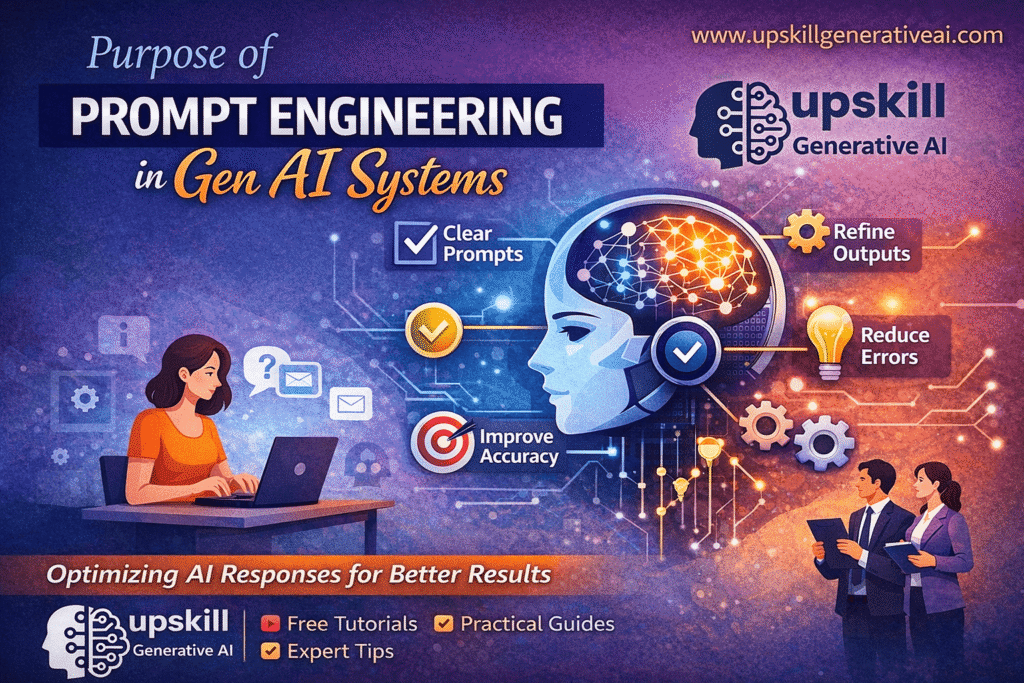
Purpose of Prompt Engineering in Gen AI Systems
Introduction
Generative AI systems have grown rapidly in recent years and are now widely used in content creation, education, software development, marketing, and customer support. These systems can generate human-like text, images, code, and even audio within seconds. However, the quality of these outputs depends heavily on one critical factor: human input.
The instructions we give to AI—called prompts—play a major role in determining what the AI produces. A poorly written prompt can lead to inaccurate or irrelevant results, while a well-crafted prompt can unlock the full potential of the AI.
This is where prompt engineering comes in. Prompt engineering acts as a guiding mechanism that helps AI systems understand user intent clearly and respond more accurately.
In this blog, you will learn what prompt engineering is, why it is important in generative AI systems, key techniques, challenges, best practices, and its future scope.
Click Here : Generative AI Training in Hyderabad
Understanding Generative AI Systems
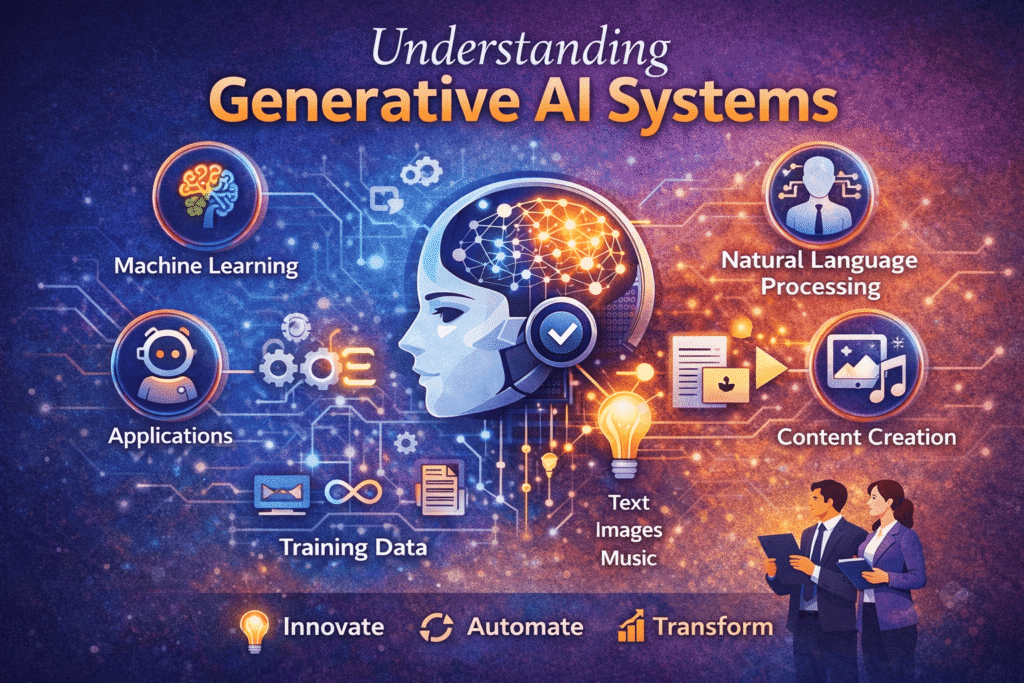
What are Generative AI systems?
Generative AI systems are artificial intelligence models designed to create new content rather than just analyze existing data. Unlike traditional AI, which focuses on prediction or classification, generative AI produces original outputs based on patterns learned from large datasets.
Types of outputs generated by Gen AI
Generative AI can create:
- Text (articles, emails, summaries, chat responses)
- Images (art, designs, illustrations)
- Code (scripts, applications, debugging support)
- Audio and video (voice generation, music, visual content)
How Gen AI models interpret user instructions
Gen AI models do not think like humans. They rely entirely on the instructions provided by users. The AI analyzes the words, structure, and context of a prompt to predict the most suitable response.
Limitations of Gen AI without well-structured prompts
Without clear prompts, Gen AI may:
- Misinterpret user intent
- Generate vague or generic responses
- Produce incorrect or misleading information
- Fail to follow the desired format or tone
This limitation makes prompt engineering essential for effective AI usage.
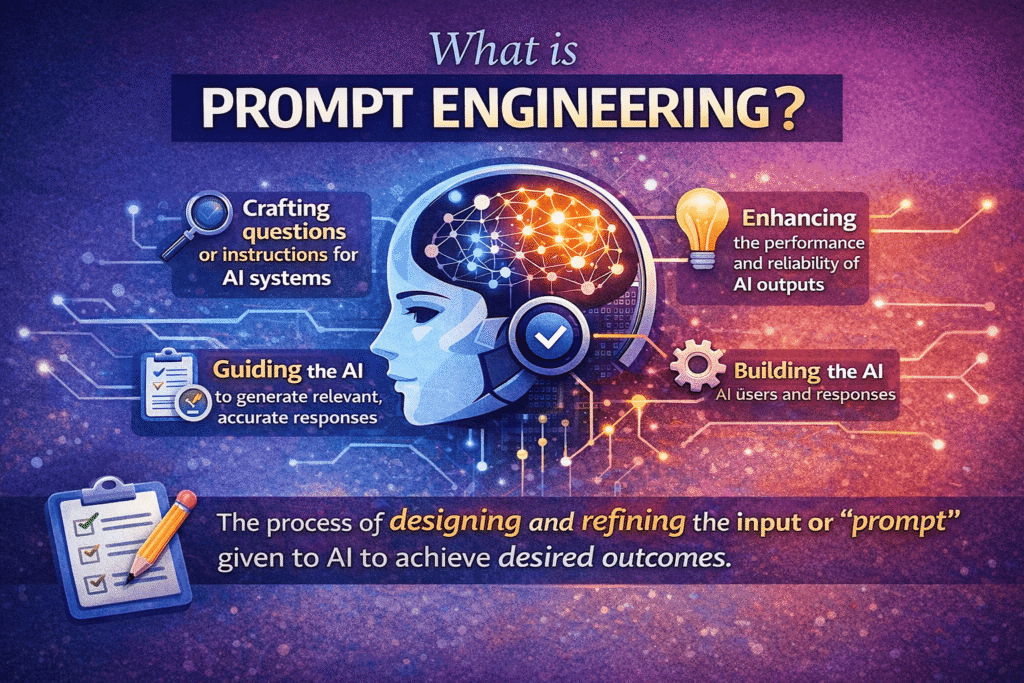
Prompt engineering is one of the most important skills when working with Generative AI systems. While AI models are powerful, they do not automatically understand human intent. Prompt engineering acts as a communication layer that helps humans clearly guide AI systems to produce accurate, relevant, and meaningful outputs.
In simple words, prompt engineering is the art and science of communicating effectively with AI.
3.1 Definition of Prompt Engineering
Prompt engineering is the process of designing, structuring, and refining prompts to control how a generative AI model responds. It focuses on improving the quality of AI outputs by carefully choosing words, context, instructions, and constraints.
Instead of relying on trial and error, prompt engineering provides a systematic way to get better results from AI systems.
Simple explanation:
Prompt engineering means telling the AI what to do, how to do it, and how the final answer should look.
For example:
- A basic prompt may give a general answer.
- A well-engineered prompt gives a detailed, accurate, and goal-oriented response.
Prompt engineering helps users:
- Reduce incorrect or irrelevant outputs
- Improve clarity and consistency
- Reduce incorrect or irrelevant outputs
- Save time and effort
Difference Between a Prompt and Prompt Engineering
Even though the terms sound similar, they mean different things.
- A prompt is a single instruction or question given to the AI.
Example: “Explain Generative AI.” - Prompt engineering is the process of improving that prompt by adding clarity, structure, and intent.
Example: “Explain Generative AI in simple terms for beginners, using bullet points and real-world examples.”
Prompt engineering turns a basic request into a powerful instruction that produces high-quality output.
3.2 Components of a Prompt
A strong prompt is usually made up of multiple components working together. Understanding these components is key to mastering prompt engineering.
1. Instruction
The instruction tells the AI exactly what task it needs to perform.
- Write
- Explain
- Summarize
- Compare
- Generate
- Analyze
Clear instructions prevent confusion and improve accuracy.
2. Context
Context gives background details that help the AI clearly understand the situation and respond more accurately.
- Who the audience is
- Why the content is needed
- What level of detail is required
Without context, AI responses may be too generic or misaligned with expectations.
3. Constraints
Constraints define limits and boundaries for the AI response.
Examples include:
- Word count
- Tone (formal, casual, professional)
- Style (beginner-friendly, technical, marketing)
- Language or region
Constraints help control the output and make it more usable.
4. Output Format
The output format specifies how the final answer should be structured.
Examples:
- Bullet points
- Tables
- Step-by-step explanation
- Headings and subheadings
Defining the format improves readability and saves post-editing time.
3.3 Prompt Engineering vs Traditional Programming
Prompt engineering is very different from traditional programming, even though both are used to control system behavior.
Traditional Programming
- Uses strict rules and logic
- Requires coding skills
- Outputs are predictable and fixed
- Changes require rewriting code
Prompt Engineering
- Uses natural language
- Can be used by non-technical users
- Outputs are flexible and creative
- Changes can be made instantly by modifying prompts
Prompt engineering allows users to interact with AI in a more natural and intuitive way, making AI accessible to writers, marketers, students, educators, and business professionals.
Why Prompt Engineering is More Flexible and User-Friendly
Prompt engineering:
- Does not require programming knowledge
- Allows rapid experimentation
- Adapts easily to different use cases
- Encourages creativity and exploration
This flexibility is one of the main reasons prompt engineering has become a core skill in the Gen AI era.
3.4 Why Prompt Engineering Matters More Than the AI Model Itself
Even the most advanced AI model cannot perform well without clear instructions. Prompt engineering ensures that:
- The AI understands user intent correctly
- Outputs match real-world requirements
- Users can control AI behavior without technical changes
In many cases, a well-written prompt with a basic AI model can outperform a poorly written prompt with an advanced model.
3.5 Prompt Engineering as a Human-AI Collaboration Skill
Prompt engineering is not just a technical task—it is a collaboration skill. Humans provide:
- Creativity
- Judgment
- Goals
- Ethical awareness
AI provides:
- Speed
- Scale
- Pattern recognition
- Content generation
Prompt engineering connects these strengths, enabling humans and AI to work together effectively.
Click Here : Prompt Engineering Course in Hyderabad
Purpose of Prompt Engineering in Gen AI Systems
Prompt engineering serves as the foundation for effective interaction between humans and generative AI systems. While Gen AI models are powerful, they do not inherently understand human goals, emotions, or expectations. Prompt engineering fills this gap by shaping how instructions are delivered and interpreted, ensuring AI outputs are accurate, relevant, and aligned with user intent.
4.1 Translating Human Intent into AI Instructions
Humans often think in abstract ideas, goals, or outcomes, while AI systems operate strictly on patterns in language. Prompt engineering acts as a translator between human thinking and machine understanding.
A well-designed prompt:
- Converts vague ideas into clear instructions
- Reduces misinterpretation of user intent
- Helps AI focus on the exact task required
For example, instead of giving a general instruction, prompt engineering encourages users to clearly define what, why, and how they want the AI to respond. This translation of intent is critical for achieving meaningful and usable outputs.
4.2 Improving Output Accuracy
One of the main purposes of prompt engineering is to improve the accuracy of AI-generated responses. When prompts are unclear or incomplete, AI may generate partially correct, overly generic, or even incorrect information.
Prompt engineering improves accuracy by:
- Narrowing the scope of the task
- Reducing assumptions made by the AI
- Guiding the model toward the correct context
By specifying details such as target audience, expected depth, or constraints, prompt engineering significantly reduces errors and increases reliability.
4.3 Enhancing Response Relevance
Generative AI can generate a large amount of information, but not all of it may be relevant to the user’s needs. Prompt engineering ensures that AI responses stay focused, on-topic, and aligned with expectations.
Through effective prompting:
- Irrelevant information is minimized
- Responses match the user’s specific goal
- Output quality improves without extra editing
This is especially important in professional settings such as education, business, and technical documentation, where relevance directly impacts productivity.
4.4 Controlling Tone, Style, and Format
Another key purpose of prompt engineering is controlling how the AI communicates, not just what it communicates. Different situations require different tones and formats.
Prompt engineering allows users to define:
- Tone (formal, casual, persuasive, instructional)
- Writing style (simple, technical, conversational)
- Output structure (paragraphs, bullet points, tables)
This control makes AI outputs more suitable for specific use cases such as marketing copy, academic content, customer communication, or internal documentation.
4.5 Maximizing AI Capabilities
Generative AI models are capable of much more than basic content generation. However, without effective prompts, much of this potential remains unused.
Prompt engineering helps users:
- Unlock advanced reasoning abilities
- Generate deeper and more structured responses
- Handle complex or multi-step tasks efficiently
By refining prompts, users can push AI systems to deliver higher-quality insights, creative solutions, and well-organized outputs—without changing the model itself.
4.6 Reducing Trial-and-Error in AI Usage
Without prompt engineering, users often rely on repeated trial-and-error to get acceptable results. One purpose of prompt engineering is to reduce wasted effort by guiding AI responses more precisely from the start.
Well-engineered prompts:
- Save time
- Reduce repeated corrections
- Improve consistency across outputs
This makes AI systems more efficient and dependable, especially in high-volume or time-sensitive tasks.
4.7 Enabling Scalable and Repeatable AI Interactions
In business and enterprise environments, consistency matters. Prompt engineering enables standardized prompts that can be reused across teams, projects, and workflows.
This helps in:
- Maintaining consistent quality
- Scaling AI usage across departments
- Training teams to use AI effectively
As a result, prompt engineering becomes not just a skill, but a strategic asset for organizations using generative AI at scale.
4.8 Supporting Responsible and Controlled AI Use
Prompt engineering also plays a role in responsible AI usage. By clearly defining boundaries and constraints, users can reduce the risk of misleading, biased, or inappropriate outputs.
Purpose-driven prompts help:
- Limit unwanted responses
- Encourage factual and neutral outputs
- Support ethical and controlled AI behavior
This ensures that AI systems remain supportive tools rather than unpredictable systems.
Importance of Prompt Engineering for Different Use Cases
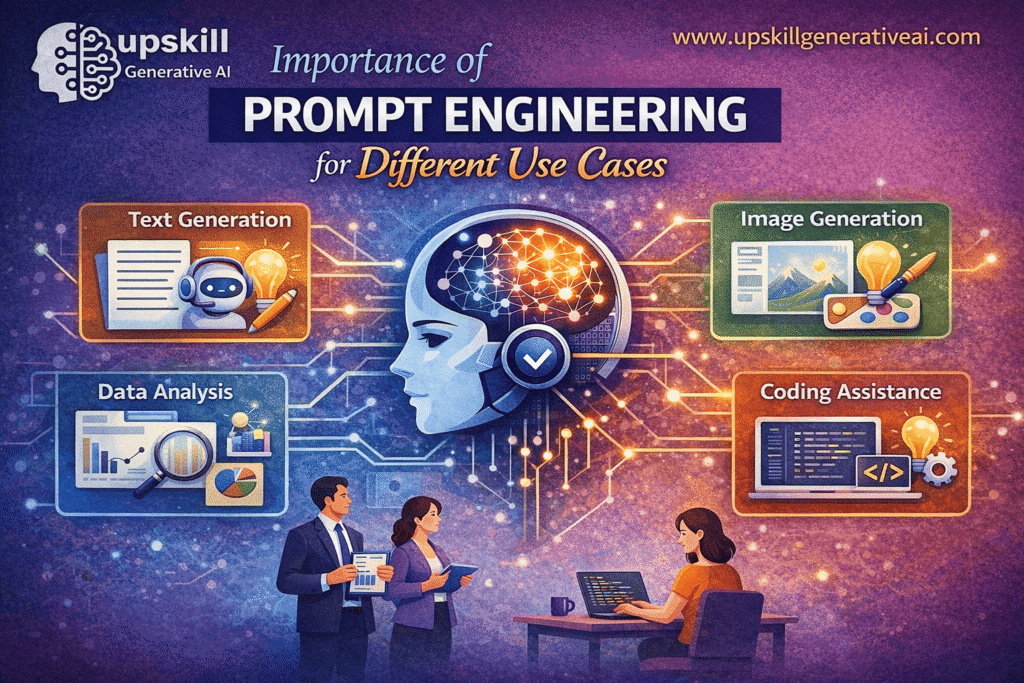
Prompt engineering is not limited to a single domain. Its importance increases as generative AI is adopted across industries and professions. Well-designed prompts help AI systems deliver more accurate, relevant, and context-aware outputs for specific use cases. Each domain benefits differently from effective prompt engineering.
5.1 Content Creation
In content creation, prompt engineering plays a crucial role in shaping creativity, tone, and structure. Content creators rely on prompts to generate:
- Blog articles and long-form content
- Social media captions and reels scripts
- Marketing copy and advertisements
- SEO-optimized website content
A well-crafted prompt can instruct the AI to follow a specific writing style, target a particular audience, or include keywords naturally. Without proper prompting, the content may appear generic, repetitive, or misaligned with brand voice. Prompt engineering ensures consistency, originality, and relevance in AI-generated content.
5.2 Education and Learning
In education, prompt engineering helps transform generative AI into an effective learning assistant. Educators and students use prompts to:
- Explain complex topics in simple language
- Generate summaries and notes
- Create quizzes, practice questions, and study plans
- Support personalized learning
By refining prompts, learners can adjust the difficulty level, request step-by-step explanations, or ask for real-world examples. This makes AI a flexible and adaptive educational tool rather than a one-size-fits-all solution.
5.3 Business and Productivity
Businesses increasingly use generative AI to improve efficiency and decision-making. Prompt engineering enables AI to assist with:
- Writing professional emails and reports
- Creating presentations and meeting summaries
- Automating routine documentation
- Supporting data interpretation and insights
Clear prompts help AI understand business context, maintain professional tone, and follow organizational standards. This reduces manual effort and saves time while improving the quality of outputs.
5.4 Software and Technical Tasks
For developers and technical professionals, prompt engineering enhances AI’s ability to support coding and development tasks such as:
- Writing and explaining code
- Debugging errors
- Generating technical documentation
- Assisting with system design ideas
Structured prompts with clear objectives, programming language specifications, and constraints lead to more accurate and usable technical outputs. Prompt engineering helps bridge the gap between human logic and machine-generated code.
5.5 Customer Support and Chatbots
Prompt engineering is essential for building effective AI-powered chatbots and virtual assistants. In customer support, prompts help AI:
- Understand customer intent correctly
- Respond politely and professionally
- Provide consistent and accurate information
- Handle follow-up questions smoothly
Well-designed prompts improve conversational flow, reduce misunderstandings, and create a more human-like interaction experience. This leads to higher customer satisfaction and better support efficiency.
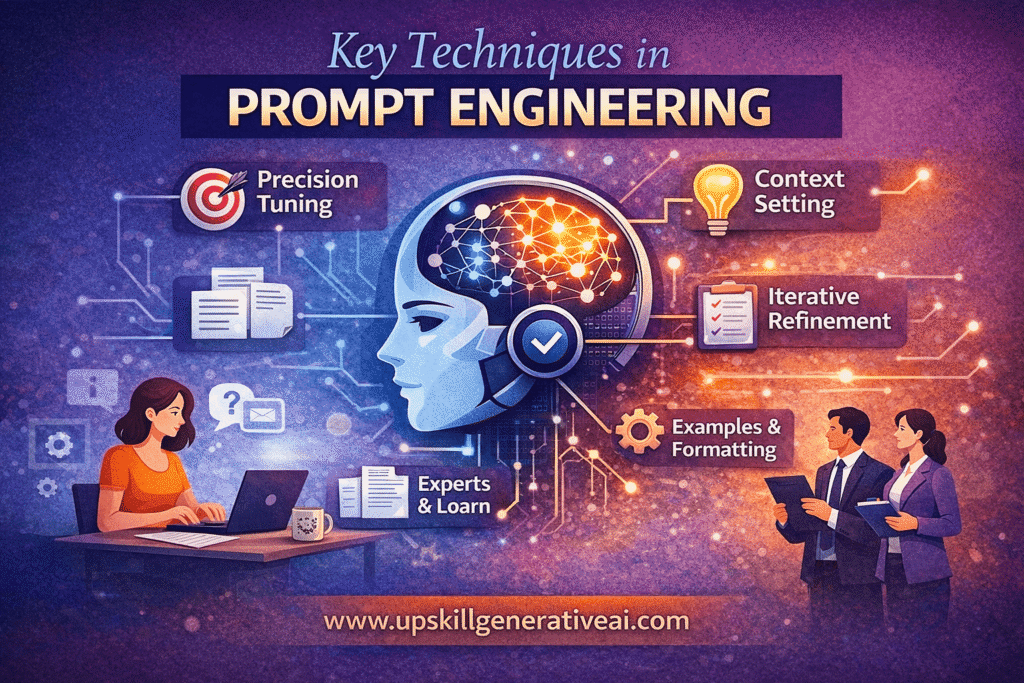
Prompt engineering is not just about writing instructions—it is about communicating clearly with AI systems. The techniques below help users get more accurate, relevant, and consistent outputs from generative AI models.
6.1 Clear and Specific Instructions
One of the most important techniques in prompt engineering is being clear and specific. AI models perform best when they receive direct instructions.
- Avoid vague prompts like “Write about AI”
- Use clearly defined prompts such as, “Write a 500-word, beginner-friendly article that explains the benefits of generative AI in education.”
Clear instructions reduce confusion and help the AI focus on exactly what the user wants.
Why this matters:
- Improves accuracy
- Reduces irrelevant responses
- Improves accuracy
- Saves time by minimizing rework
6.2 Providing Proper Context
Context helps the AI understand the background and goal of the task. Without context, AI may generate generic or misaligned responses.
For example:
- Who is the target audience?
- What is the goal of the content?
- What level of knowledge should the response assume?
Example:
Instead of “Explain prompt engineering”, use
“Explain prompt engineering to beginners with no technical background, using easy-to-understand examples.”
Providing context ensures responses are more relevant and meaningful.
6.3 Step-by-Step Prompting
Step-by-step prompting guides the AI through a logical process instead of expecting a perfect answer all at once.
This technique is useful for:
- Problem-solving
- Tutorials
- Technical explanations
- Decision-making tasks
Example approach:
- Ask the AI to explain the concept
- Then ask for examples
- Then ask for advantages or applications
Step-by-step prompting improves logical flow, clarity, and depth in AI-generated outputs.
6.4 Role-Based Prompting
Role-based prompting involves assigning a specific role or identity to the AI before giving instructions.
Examples:
- “Act as a digital marketing expert”
- “You are a beginner-friendly AI instructor”
- “Respond as a professional technical writer”
This technique helps AI:
- Match the required tone and expertise
- Use appropriate language and terminology
- Deliver more focused responses
Role-based prompting is especially effective for education, consulting, marketing, and professional writing tasks.
6.5 Example-Based Prompting
Example-based prompting uses sample inputs or outputs to show the AI what kind of response is expected.
This technique is useful when:
- A specific format is required
- Consistency is important
- Creativity needs direction
Example:
“Here is an example of the output format. Generate a similar response using the same style.”
Providing examples reduces trial-and-error and helps AI closely match expectations.
6.6 Output Formatting Techniques
Formatting instructions help AI present information in a structured and readable way.
You can ask AI to:
- Use bullet points
- Create tables
- Write short paragraphs
- Add headings and subheadings
- Summarize content in key points
Why formatting matters:
- Improves readability
- Makes content easier to scan
- Enhances professional presentation
This technique is widely used in blogs, reports, documentation, and presentations.
6.7 Constraint-Based Prompting
Constraints define boundaries for the AI response.
Common constraints include:
- Word or character limits
- Tone (formal, casual, professional)
- Language level (beginner, intermediate)
- Avoiding specific topics or terms
By setting constraints, users gain greater control over the final output.
6.8 Iterative Prompt Refinement
Prompt engineering is an iterative process. Rarely does the first prompt deliver a perfect result.
This technique involves:
- Reviewing AI responses
- Identifying gaps or issues
- Refining the prompt accordingly
Iterative refinement helps users gradually achieve high-quality, precise results.
6.9 Combining Multiple Techniques
The most effective prompt engineering often combines several techniques together, such as:
- Role-based + context-rich prompts
- Step-by-step + formatting instructions
- Examples + constraints
Combining techniques allows users to fully leverage AI capabilities and achieve professional-level outputs.
Click Here : Mlops Training in Hyderabad
Prompt Optimization and Iteration
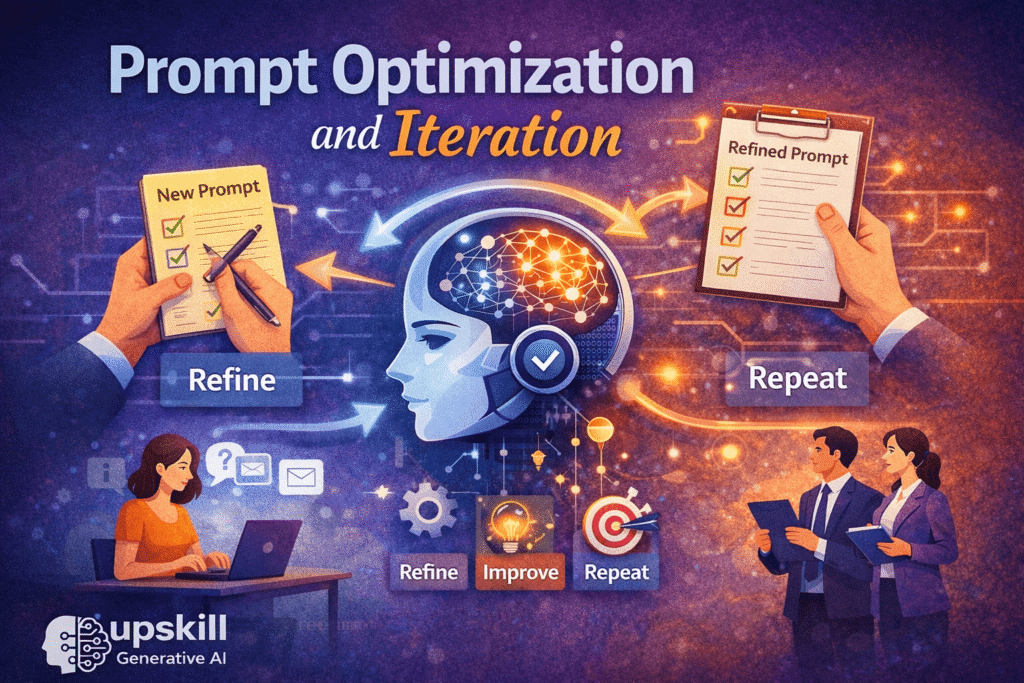
Prompt engineering is not a one-time activity. Even well-written prompts may not always produce the expected results on the first attempt. This is because generative AI systems work on probabilities and patterns rather than fixed rules. Prompt optimization and iteration help bridge the gap between what users expect and what the AI delivers.
7.1 Why First Prompts Rarely Deliver Perfect Results
The first prompt often serves as a starting point rather than a final solution. AI models may:
- Interpret instructions differently than intended
- Focus on less important details
- Miss the desired tone, depth, or format
Small changes in wording, order, or context can significantly alter the output. This makes refinement essential for consistent and accurate results.
7.2 The Role of Iteration in Prompt Engineering
Iteration means repeatedly improving prompts based on AI responses. Each interaction provides insights into how the AI understands instructions. By observing outputs, users can:
- Identify unclear or misleading phrases
- Adjust instructions to be more precise
- Add or remove context as needed
This iterative process gradually improves output quality and relevance.
7.3 Techniques for Optimizing Prompts
Effective prompt optimization involves several practical techniques:
- Refining Language: Replacing vague terms with specific instructions
- Reordering Information: Placing the most important instruction at the beginning
- Adding Constraints: Limiting word count, tone, or structure
- Clarifying Output Expectations: Explicitly stating the desired format
These adjustments help the AI focus on what truly matters.
7.4 Learning from AI Responses
Each AI-generated response acts as feedback. Instead of discarding imperfect outputs, users can analyze them to understand:
- Which parts of the prompt were misunderstood
- Where the AI added unnecessary information
- What instructions need more clarity
This learning loop turns AI interaction into a continuous improvement process.
7.5 Trial-and-Error as a Natural Process
Trial-and-error is not a weakness in prompt engineering—it is a strength. Testing multiple prompt variations allows users to:
- Discover what works best for specific tasks
- Compare output quality across prompt versions
- Build reusable prompt templates for future use
Over time, this experimentation leads to faster and more reliable AI interactions.
7.6 Prompt Versioning and Reusability
For professional and business use cases, maintaining different versions of prompts is highly beneficial. Prompt versioning helps:
- Track improvements over time
- Reuse high-performing prompts
- Standardize AI outputs across teams
Well-tested prompts can be stored as templates and adapted for similar tasks.
7.7 Continuous Improvement for Long-Term Success
As AI models evolve, prompt strategies must also adapt. What works today may need refinement tomorrow. Continuous learning, experimentation, and adaptation ensure that prompts remain effective and aligned with changing AI capabilities.
Prompt optimization and iteration transform prompt engineering from a basic skill into a strategic advantage, enabling users to consistently extract high-quality, accurate, and relevant outputs from generative AI systems.
Challenges in Prompt Engineering
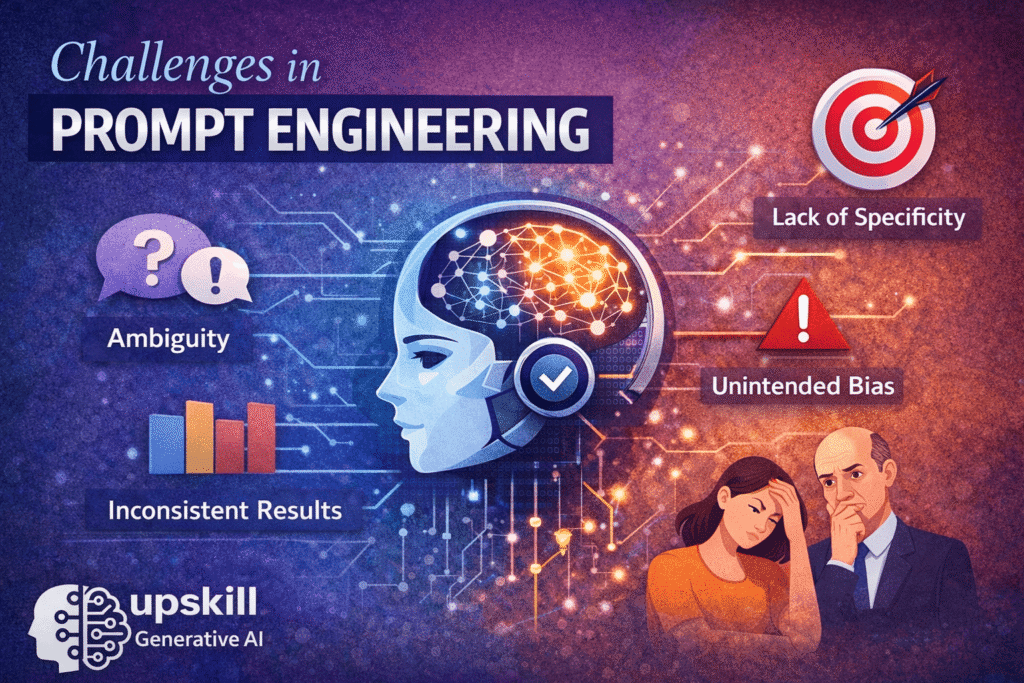
While prompt engineering enhances the performance of generative AI systems, it also presents certain challenges. Understanding these limitations helps users design better prompts and avoid common mistakes that lead to poor or unreliable outputs.
8.1 Ambiguity in Prompts
Ambiguity is one of the most common challenges in prompt engineering. When prompts are unclear or vague, AI systems find it difficult to understand the user’s intent.For example, a prompt such as “Write about AI” is too broad and often leads to generic or unfocused output. The AI lacks clarity about the audience, tone, depth, and purpose.
Why this happens:
- AI models rely entirely on the words provided
- Missing context leads to multiple possible interpretations
How to overcome it:
- Use clear and specific instructions
- Define the topic, audience, and purpose
- Include constraints such as length or format
8.2 Inconsistent AI Responses
Even with similar prompts, generative AI systems may produce different outputs each time. This inconsistency can be confusing, particularly in professional or business settings.
Reasons for inconsistency:
- AI responses are probability-based, not fixed
- Small changes in wording can affect results
- Model randomness and creativity settings
How to manage it:
- Use structured and repeatable prompts
- Clearly define output format and tone
- Test prompts multiple times and refine them
- Save effective prompts for reuse
8.3 Over-Prompting and Prompt Complexity
including too much information in a single prompt can overwhelm the AI and lower the quality of the output. Over-prompting often leads to confusing, incomplete, or poorly structured responses.
Common signs of over-prompting:
- Long and cluttered prompts
- Multiple unrelated instructions
- Conflicting constraints
Best practices to avoid over-prompting:
- Break complex tasks into smaller prompts
- Focus on one goal at a time
- Use step-by-step prompting instead of one large instruction
8.4 Bias and AI Hallucinations
Generative AI systems can sometimes produce incorrect, misleading, or biased content. This problem, known as AI hallucination, occurs when the AI generates information that sounds confident but is not factual.
Why hallucinations occur:
- Training data limitations
- Lack of real-time verification
- Poorly defined or leading prompts
Ways to reduce hallucinations:
- Instruct the AI to cite its sources or explicitly mention any assumptions made.
- Use prompts that encourage factual accuracy
- Manually verify important information
- Avoid prompts that encourage speculation
8.5 Difficulty in Handling Complex or Multi-Step Tasks
AI systems may find it difficult to handle multi-step tasks, logical reasoning, or in-depth analysis when prompts are poorly structured.
Examples include:
- Technical problem-solving
- Business decision analysis
- Long-form content creation
Solution:
- Use step-by-step or sequential prompting
- Guide the AI through each stage of reasoning
- Review outputs at every step
8.6 Over-Reliance on Prompt Engineering
Another challenge lies in over-reliance on AI-generated outputs without sufficient human oversight. Even well-engineered prompts cannot guarantee perfect results.
Risks of over-reliance:
- Accepting incorrect outputs without verification
- Reduced critical thinking
- Ethical and legal risks in professional settings
Balanced approach:
- Treat AI as a supportive tool, not a replacement for human judgment.
- Always review, edit, and validate outputs
- Combine AI efficiency with human expertise
8.7 Skill Gap and Learning Curve
Prompt engineering is a skill that develops through consistent practice. Beginners may struggle initially to write effective prompts or understand why outputs vary.
How to overcome the learning curve:
- Practice regularly with different prompts
- Learn from examples and templates
- Analyze successful prompts and reuse patterns
- Stay updated with AI model improvements
8.8 Maintaining Consistency at Scale
For organizations using AI at scale, ensuring consistent outputs across teams can be a challenge.
Solutions:
- Create prompt guidelines and templates
- Standardize prompts for common tasks
- Document successful prompt strategies
- Train teams on prompt engineering best practices
Click Here : Agentic AI Training in Hyderabad
Ethical and Practical Considerations
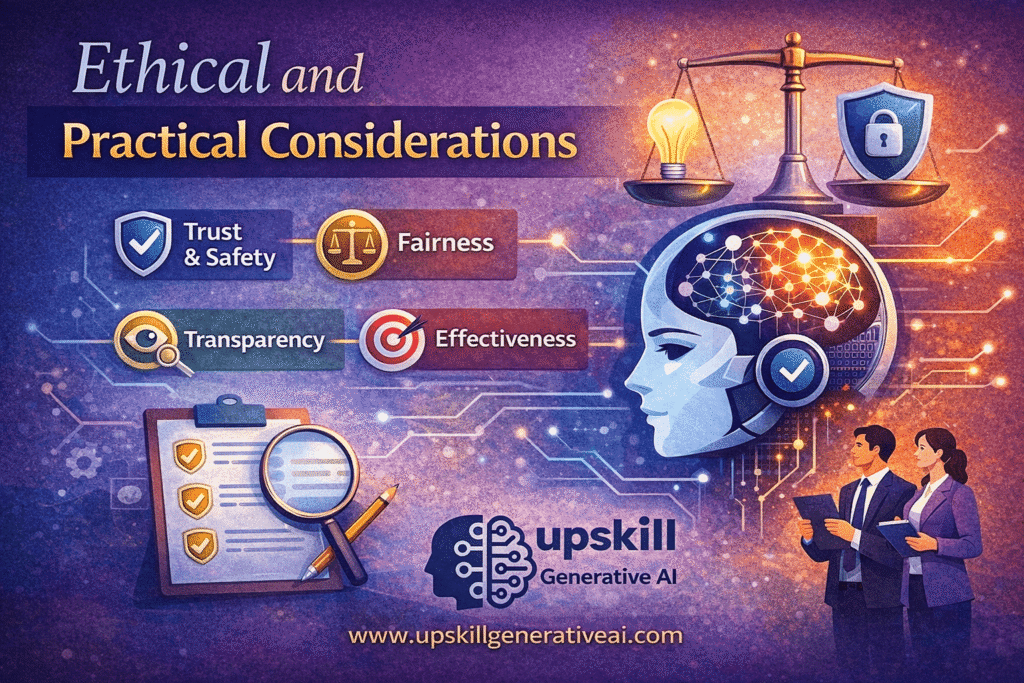
As generative AI systems become more integrated into daily workflows, ethical and practical responsibility in prompt engineering becomes increasingly important. While prompt engineering can significantly enhance AI performance, careless or irresponsible use can lead to misinformation, bias, and misuse. Understanding these considerations helps users apply AI in a safe, reliable, and trustworthy way.
9.1 Responsible Use of AI-Generated Content
AI-generated outputs should be treated as assistance, not absolute truth. Prompt engineers and users must ensure that AI is used to support creativity, decision-making, and productivity rather than replacing human responsibility.
Responsible usage includes:
- Clearly distinguishing AI-generated content from human-written content when required
- Avoiding the spread of false or misleading information
- Using AI outputs ethically in academic, professional, and public settings
Prompt engineering should always aim to enhance human work, not compromise integrity or originality.
9.2 Avoiding Blind Trust in AI Outputs
Generative AI systems can produce responses that sound confident but are factually incorrect. This phenomenon is often referred to as AI hallucination.
To reduce risk:
- Always cross-check important facts
- Avoid using AI-generated content directly for legal, medical, or financial decisions
- Treat AI responses as drafts or suggestions rather than final answers
Prompt engineering should encourage accuracy, but human validation remains essential.
9.3 Managing Bias and Fairness
AI models learn from large datasets that may contain cultural, social, or historical biases. As a result, AI outputs can unintentionally reflect biased viewpoints.
Ethical prompt engineering involves:
- Writing neutral and inclusive prompts
- Avoiding leading questions that reinforce stereotypes
- Reviewing outputs for fairness and balance
- Refining prompts to encourage unbiased and respectful responses
Addressing bias ensures AI systems are used responsibly and inclusively.
9.4 Data Sensitivity and Privacy Awareness
Prompt engineers must be cautious when handling sensitive or confidential information. AI systems should never be used to process:
- Personal identification details
- Confidential business data
- Financial or medical records
Best practices include:
- Avoiding real names or private data in prompts
- Using anonymized or hypothetical examples
- Following organizational data protection policies
Protecting data privacy builds trust and ensures ethical AI usage.
9.5 Human Oversight and Accountability
Even the best prompts cannot replace human judgment. AI systems do not understand consequences, ethics, or accountability.
Human oversight ensures:
- Outputs align with ethical standards
- Errors are identified and corrected
- Final decisions remain in human control
Prompt engineering should always function as a collaborative process between humans and AI.
9.6 Legal and Compliance Considerations
AI-generated content may raise legal concerns related to:
- Copyright
- Intellectual property
- Content ownership
- Regulatory compliance
Prompt engineers should be aware of:
- Platform usage policies
- Industry regulations
- Legal boundaries related to AI-generated material
Using prompts responsibly helps organizations avoid legal risks.
9.7 Long-Term Impact of AI Dependency
Over-reliance on AI systems can reduce critical thinking and creativity if not managed properly.
To maintain balance:
- Use AI as a productivity tool, not a replacement for thinking
- Encourage learning and skill development alongside AI usage
- Combine AI insights with human experience and reasoning
Prompt engineering should empower users, not create dependency.
9.8 Ethical Prompt Engineering as a Skill
Ethical awareness is becoming a core part of prompt engineering expertise. Skilled prompt engineers understand not only how to guide AI, but also when and why to use it responsibly.
Ethical prompt engineering focuses on:
- Transparency
- Accuracy
- Accountability
- Respect for human values
Best Practices for Effective Prompt Engineering
Effective prompt engineering is not just about writing instructions—it is about communicating clearly with AI systems. By following proven best practices, users can consistently generate accurate, relevant, and high-quality outputs across different use cases.
10.1 Keep Prompts Simple and Goal-Focused
Always begin with a clear objective in mind. A prompt should focus on one primary goal rather than trying to achieve multiple tasks at once. Overloading a prompt with too many instructions can confuse the AI and reduce output quality.
Simple prompts lead to clearer reasoning and more reliable responses.
10.2 Use Clear, Direct, and Structured Language
Avoid vague words or open-ended instructions. Use direct language that clearly states what you want the AI to do. Structuring prompts with bullet points, numbered steps, or sections helps the AI understand priorities and follow instructions in the correct order.
10.3 Provide Relevant Context, Not Excessive Details
Context helps AI understand why a task is being performed. However, only include information that directly supports the goal of the prompt. Too much background information can distract the AI and reduce clarity. The key is balanced context—enough to guide, but not overwhelm.
10.4 Define Output Expectations Clearly
Always specify how you want the output to look. This may include:
- Word count or length
- Tone (formal, casual, professional)
- Format (paragraphs, bullet points, table, summary)
Clear output expectations reduce rework and improve consistency.
10.5 Use Role-Based Instructions When Appropriate
Assigning a role to the AI—such as teacher, marketing expert, recruiter, or software developer—helps narrow the AI’s perspective. Role-based prompts result in more targeted and context-aware responses, especially for professional and educational tasks.
10.6 Leverage Examples to Guide the AI
Providing sample inputs or expected outputs is one of the most powerful prompt engineering techniques. Examples reduce ambiguity and guide the AI toward the desired structure, tone, and style. This approach is especially useful for content creation and formatting tasks.
10.7 Refine Prompts Through Iteration
Prompt engineering is an iterative process. If the output is not satisfactory, adjust:
- Keywords
- Sentence structure
- Level of detail
- Constraints
Each refinement improves alignment between user intent and AI output.
10.8 Validate and Edit AI-Generated Outputs
AI-generated content should always be reviewed. Users must check for:
- Accuracy of information
- Logical consistency
- Bias or misleading statements
- Grammar and clarity
Human validation ensures trust, reliability, and ethical use of AI outputs.
10.9 Maintain Ethical and Responsible Prompt Usage
Avoid prompts that encourage misinformation, harmful content, or misuse of data. Responsible prompt engineering respects privacy, avoids sensitive data exposure, and ensures ethical content creation.
10.10 Continuously Learn and Adapt Prompting Strategies
AI models evolve, and so should prompting techniques. Staying updated with new tools, prompt patterns, and best practices helps users remain effective. Continuous experimentation and learning are essential for mastering prompt engineering.
Future Scope of Prompt Engineering
Prompt engineering is rapidly evolving from a supporting skill into a core capability for anyone working with generative AI systems. As AI becomes more integrated into everyday tools, the importance of knowing how to communicate effectively with AI will continue to grow.
11.1 Growing Demand Across Industries
Organizations across industries such as education, healthcare, marketing, software development, finance, and customer support are increasingly adopting generative AI. As a result, there is a growing demand for professionals who can design effective prompts that produce accurate, safe, and high-quality outputs. Prompt engineering is no longer limited to technical roles—it is becoming essential for managers, content creators, analysts, and business leaders.
11.2 Prompt Engineering as a Career Skill
Prompt engineering is emerging as a valuable career skill rather than a short-term trend. Many roles now require employees to work alongside AI tools, and those who understand prompt design have a competitive advantage. Prompt engineering skills can enhance careers in AI, data, marketing, product management, education, and consulting. In the future, prompt engineering may become a standard requirement similar to basic computer or internet skills.
11.3 Integration with AI Tools and Workflows
Prompt engineering will increasingly be embedded into AI-powered tools and workflows. From no-code platforms to enterprise automation systems, prompts will act as the control layer that connects human goals with AI execution. This integration will allow users to automate tasks, personalize outputs, and improve efficiency without deep technical knowledge, making AI more accessible to a wider audience.
11.4 Advancements in Prompt Optimization Techniques
As AI systems evolve, prompt engineering techniques will also advance. Future developments may include prompt templates, automated prompt optimization, and AI-assisted prompt suggestions. These advancements will help users design better prompts faster while reducing trial-and-error, making AI interactions more reliable and consistent.
11.5 Role of Prompt Engineering in Next-Generation AI Systems
In next-generation AI systems, prompt engineering will play a critical role in safety, alignment, and control. Well-designed prompts will help guide AI behavior, reduce biased or misleading outputs, and ensure ethical use. Prompt engineering will act as a safeguard that aligns AI responses with human values, organizational goals, and regulatory requirements.
11.6 Prompt Engineering as a Foundation for Human-AI Collaboration
The future of AI is not about replacing humans but about collaboration. Prompt engineering enables effective communication between humans and AI, allowing both to work together efficiently. By mastering prompt engineering, users can treat AI as a powerful assistant that understands context, intent, and expectations, leading to more productive and meaningful interactions.
11.7 Long-Term Impact on Education and Learning
Prompt engineering will become an essential skill taught in schools, colleges, and professional training programs. Learning how to interact with AI systems responsibly and effectively will prepare students and professionals for an AI-driven world. Educational institutions are likely to include prompt engineering as part of digital literacy and AI education curricula.
Frequently Asked Questions (FAQs)
What is prompt engineering in generative AI?
Prompt engineering is the process of designing and refining instructions (prompts) to help generative AI systems produce accurate, relevant, and useful outputs.
Is prompt engineering a technical skill?
No. Prompt engineering does not require coding knowledge. Anyone who can clearly communicate instructions can learn and use prompt engineering effectively.
How does prompt engineering improve AI accuracy?
Well-structured prompts provide context, constraints, and clear goals, which guide the AI to generate focused and accurate responses instead of generic outputs.
What happens if prompts are unclear or vague?
Unclear prompts can confuse the AI, leading to inaccurate, irrelevant, or inconsistent results. Ambiguity is one of the most common challenges in prompt engineering.
What are common prompt engineering techniques?
Common techniques include:
- Clear and specific instructions
- Providing proper context
- Step-by-step prompting
- Role-based prompts
- Example-based prompts
- Defining output format
Can prompt engineering reduce AI hallucinations?
Yes. While it cannot eliminate hallucinations completely, clear prompts with context, constraints, and source-checking instructions can significantly reduce incorrect or misleading outputs.
Can prompt engineering reduce AI hallucinations?
Yes. While it cannot eliminate hallucinations completely, clear prompts with context, constraints, and source-checking instructions can significantly reduce incorrect or misleading outputs.
How is prompt engineering different from traditional programming?
Traditional programming uses fixed rules and logic, while prompt engineering uses natural language to guide AI behavior, making it more flexible and user-friendly.
Is prompt engineering useful for businesses?
Absolutely. Businesses use prompt engineering for content creation, customer support, automation, reporting, marketing, and decision-making to improve productivity and consistency.
What are the ethical considerations in prompt engineering?
Upskill Generative AI provides beginner-friendly tutorials, practical guides, and expert tips to help learners master prompt engineering and generative AI skills effectively.
How does Upskill Generative AI help in learning prompt engineering?
Ethical considerations include avoiding bias, verifying AI outputs, protecting sensitive data, and using AI responsibly with human oversight.
Can prompt engineering be used in education and learning?
Yes. Prompt engineering is widely used in education for explanations, summaries, quizzes, tutoring support, and personalized learning experiences.
Is prompt engineering a future-proof skill?
Yes. As AI adoption grows across industries, prompt engineering is becoming a core digital skill essential for effective human-AI collaboration
How can beginners learn prompt engineering?
Beginners can start by practicing simple prompts, experimenting with different formats, learning from AI responses, and gradually refining their instructions.
Does prompt engineering require expensive tools?
No. Prompt engineering can be practiced using free or commonly available AI tools. The key requirement is clarity and structured thinking.